Summary of live session held on Wednesday 20 May 2026, 7-8 PM BST
One of the things I love most about Moss Safari is that the more I learn, the more I realise how much I don’t know.
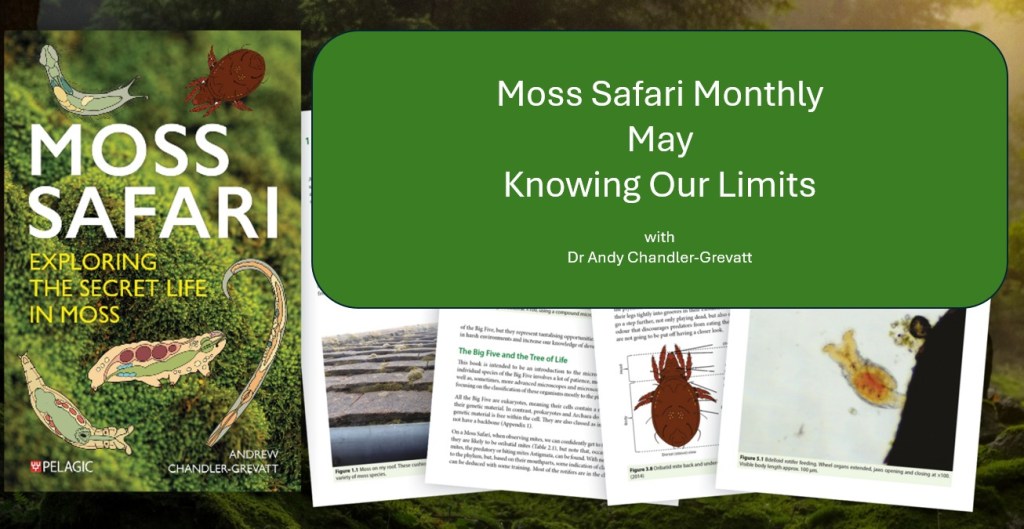
That was the theme of our fourth Moss Safari Monthly session: Knowing Our Limits.
Not just the limits of our microscopes, but the limits of our knowledge, our assumptions, and sometimes even our imagination.
Science Isn’t Finished
It’s easy to think that science has already discovered most of what there is to discover. Surely someone has already looked at moss and catalogued everything living inside it?
Not even close.
Take the Microscopic Big Five.
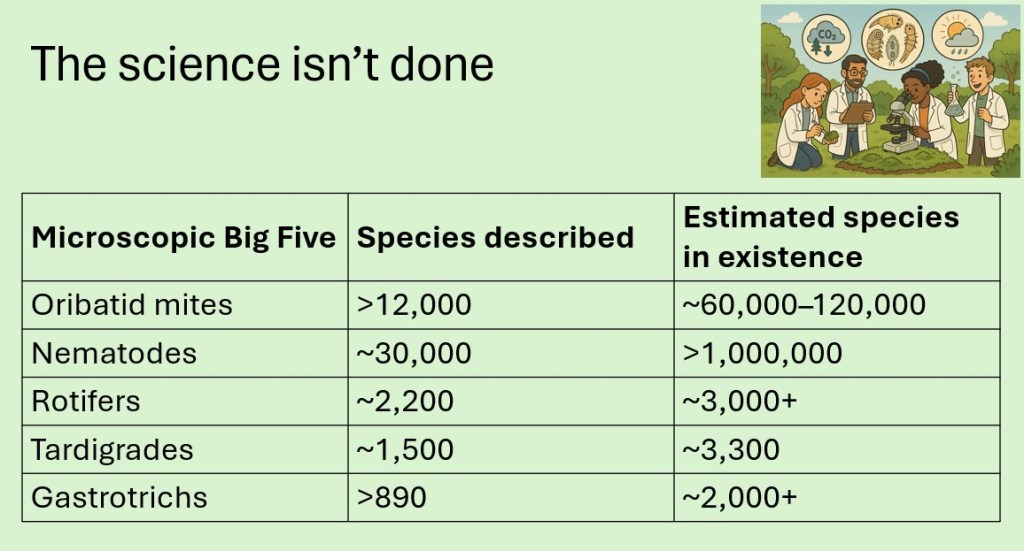
Scientists have described around 1,500 tardigrade species, yet estimates suggest there may be more than 3,000. Around 2,200 rotifer species have been described, but many more likely remain undiscovered. For nematodes, the gap is even larger: about 30,000 described species compared with estimates exceeding one million.
Every month, researchers continue to discover and describe new microscopic organisms.
Whenever we place a drop of moss water under the microscope, there is a genuine possibility that we are looking at something that science has never properly recorded before.
I find that rather exciting.
What Microscopes Can’t Show Us
Microscopes reveal extraordinary worlds, but they have limits.
Even a good light microscope can only resolve details down to around 200 nanometres. Beyond that, details blur together. We can observe tardigrades, rotifers and nematodes in remarkable detail, but we cannot see viruses. We cannot easily see the intricate machinery inside cells. We cannot see many of the processes that make life work.
Sometimes scientists overcome these limits by staining specimens, but that often means killing them first.
There is a trade-off between observing life and examining it in greater detail.
As we explored the moss samples together, that tension kept reappearing. We could see enough to be amazed, but never quite enough to satisfy our curiosity.
Rotifers and the Unexpected
One of the recurring themes of the evening was how often nature ignores the rules we think it should follow.
Take the bdelloid rotifers that regularly appear in Moss Safari samples.
For decades, biologists puzzled over how they had survived for millions of years without males. Conventional wisdom suggested that sexual reproduction was essential for long-term evolutionary success.
Yet bdelloid rotifers seem to have found another solution.
Research suggests they can incorporate DNA from other organisms in their environment, including fungi, bacteria and other microscopic life forms. They challenge assumptions about how evolution works and remind us that nature is often stranger than we expect.
Meeting Familiar Faces
The moss samples did not disappoint.
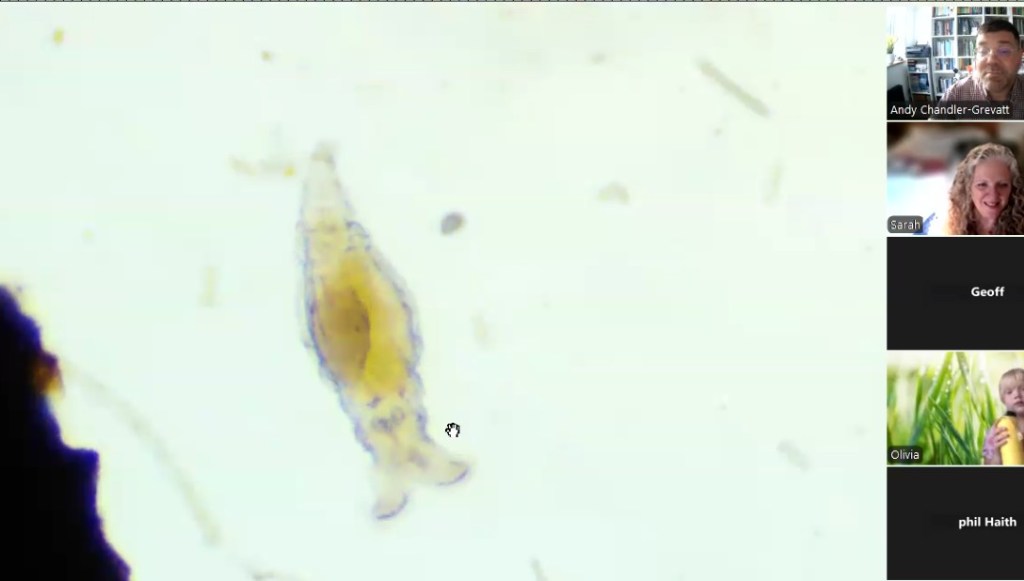
We encountered several beautiful rotifers feeding with their wheel-like crowns of cilia. Their jaws, known as trophi, could be seen opening and closing as they fed. Tiny red eyespots appeared under the microscope, detecting light despite their microscopic size.
A lively tardigrade made an appearance, busily exploring the slide. We watched its claws grip the substrate and could make out its needle-like mouthparts used to pierce food. We discussed how some tardigrades live in deep-sea trenches, others in Antarctica, and others on the moss growing quietly on a Sussex roof.
Perhaps most excitingly, we found a nematode willing to sit still long enough for a proper look. Usually they wriggle too enthusiastically to cooperate. This individual revealed its feeding apparatus, digestive tract and internal structures in surprising detail.
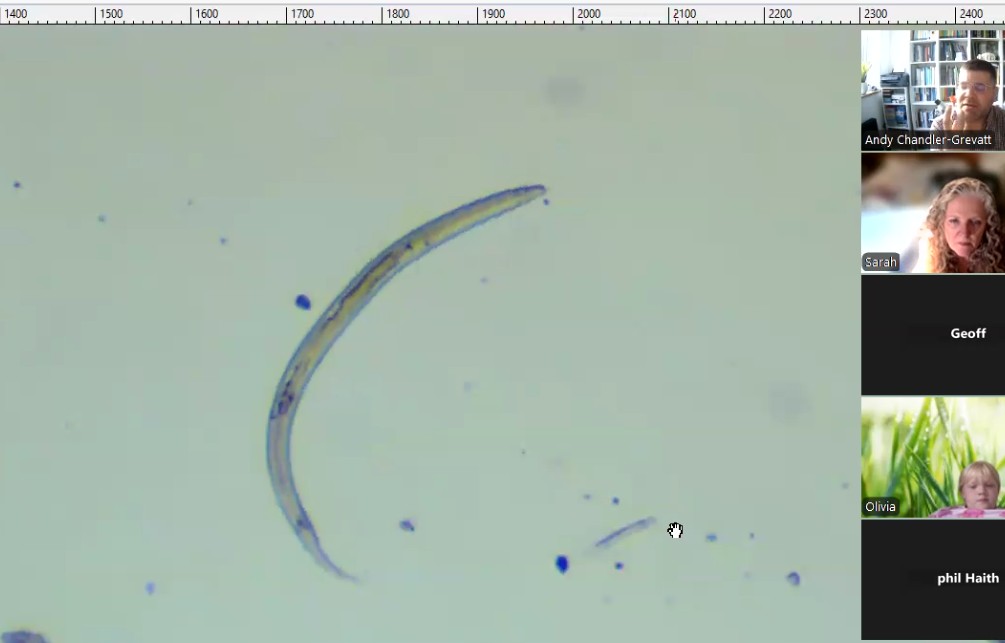
Sometimes the greatest scientific breakthrough is simply finding an organism willing to pose for a photograph.
What Is It Like to Be a Tardigrade?
At one point, our discussion drifted into philosophy.
Scientists can describe a tardigrade’s body, behaviour and genetics. We can observe how it feeds, how it moves and how it survives.
But we can never truly know what it is like to be a tardigrade.
The same question has famously been asked about bats. We can study echolocation and understand the mechanics of how bats navigate. Yet we cannot experience the world as a bat experiences it.
The same is true for every microscopic organism we encounter.
No matter how powerful our microscopes become, there will always remain aspects of their lives that we can only infer.
The Joy of Not Knowing
One of my favourite moments came when we spotted something unusual on the slide.
Was it a shed tardigrade skin?
Possibly.
Was it definitely a shed tardigrade skin?
Not at all.
Part of me wanted it to be a tardigrade ghost, the empty exoskeleton left behind after moulting. Part of me knew it might be something entirely different.
That uncertainty is not a failure of science.
It is science.
The willingness to say “I don’t know” is often where discovery begins.
Tiny Jewels
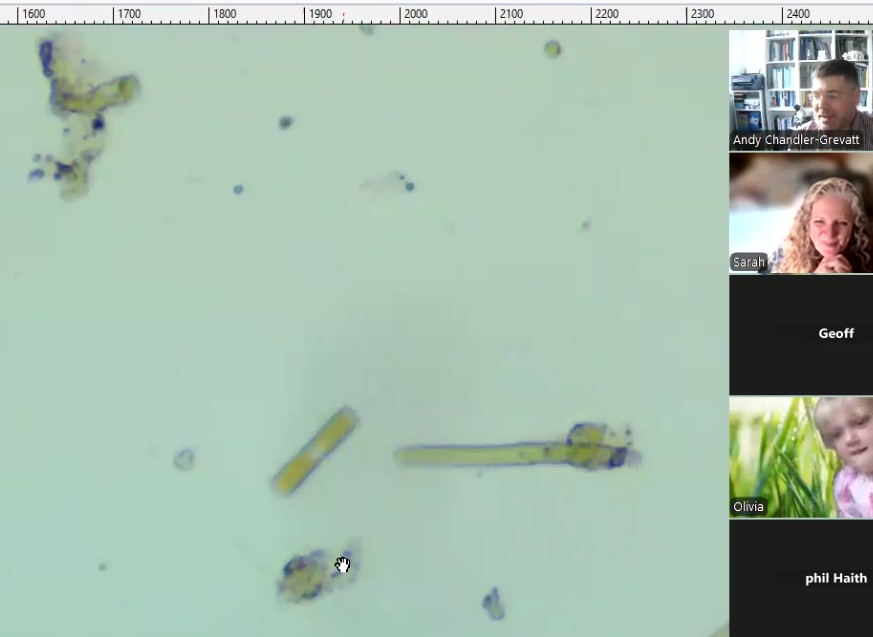
Towards the end of the session, we encountered several beautiful diatoms gliding across the slide.
Diatoms are single-celled algae encased in glass-like shells. Under the microscope they looked like tiny moving jewels, changing orientation as they moved through the water.
Watching them raised another mystery.
How does a single-celled organism decide where to go?
We understand some of the mechanisms involved, but there is still something deeply fascinating about seeing apparent purpose emerge from something so simple.
Again, the more closely you look, the more questions appear.
Final Thoughts
Moss Safari Monthly #4 reminded me that science is not really about having answers.
It is about asking better questions.
Every moss sample contains organisms we cannot identify, behaviours we do not fully understand, and species that may not even have names yet.
That is not frustrating.
That is wonderful.
The world is still full of mysteries.
Even in a drop of moss water.
And perhaps especially there.
Join us next month for the final Moss Safari Monthly 2026
Join us next month: Wed 24 Jun 2026, 7-8 BST Watching Without Taking
Find out more about Moss Safari – buy the book!
 Moss Safari