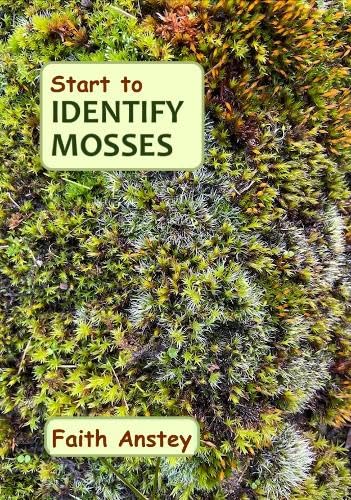
Anstey, F. (2026) Start to Identify Mosses. Wildflower Study. ISBN 9780993493386
A note on links: Some product links are Amazon affiliate links. If you choose to buy through them, Moss Safari may receive a small commission at no extra cost to you. This helps support the project, including free resources, events and microscope activities. As an Amazon Associate I earn from qualifying purchases.
In this blog, I take Faith Anstey’s latest book for a trial in identifying two mosses in my garden.
In a very small circle of people, I am known as ‘Dr Moss’. However, I always feel a bit of a fraud as I am more ‘Dr What lives in moss’ (and often I feel barely that!). You might have seen that in my attempt to get to know mosses better I developed a series of infographics to help me and others have a go at identifying mosses. Of course, somewhere, someone else was doing the same, and better. It was Faith Anstey. She got in touch with me and kindly sent me a copy of her new book Start to Identify Mosses. Here is my review.
It is difficult to convince anyone that mosses are easy to identify. Despite being very easy to find, their tiny bodies, the extraordinary amount of specialised terms we have for their bodies and their lack of consistent common names make them daunting to those wanting to start out. Faith challenges this with her book that expertly builds the knowledge you need to start identifying mosses.
The format is simple, the book is short (44 pages) and it doesn’t feel anywhere near as scary as the wonderfully detailed, but hefty, British Bryological Society’s Mosses and Liverworts of Britain and Ireland a field guide. Mosses are introduced slowly page by page, giving the right amount of detail at the right time. From why mosses are important to ‘Is it a moss?’ to the terminology of growth forms and body parts – each of these early sections with a little quiz to check your knowledge before you move on.
For the rest of the book, Faith has selected 12 acrocarps (cushion forms) and 12 pleurocarps (mat forms) and made a flow chart for identifying them, rather than than the more traditionally daunting key. She has selected the most commonly recorded mosses in these growth forms, so the chances are, the moss you find and try and identify will be in the book. As Faith says, ‘ However, once you have begun to recognise these two dozen, you will be well placed to have a stab at identifying others that you meet.’ (p.13)
I went to my garden and selected two mosses (one acrocarp and one pleurocarp). It’s an exceptionally hot May half term, so I had to revitalise the mosses with some water (Faith recommends having as spray bottle as part of your identification kit). Armed with my hand lens, phone camera and new found enthusiasm, I used Faith’s book to identify them.
The acrocarp
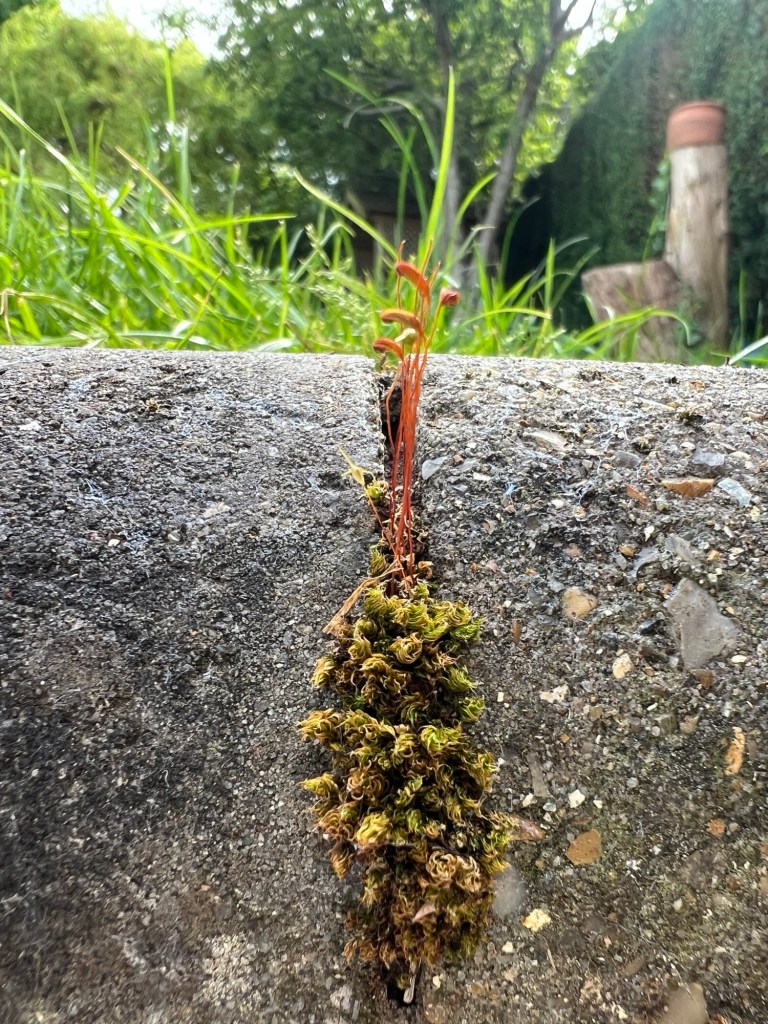
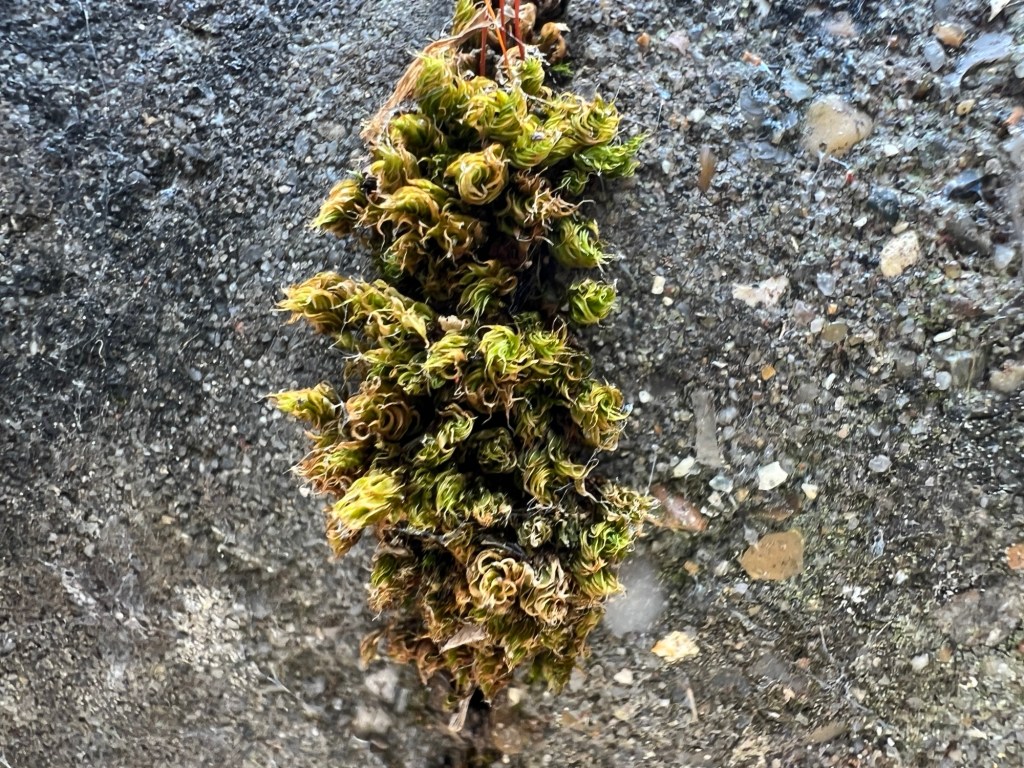
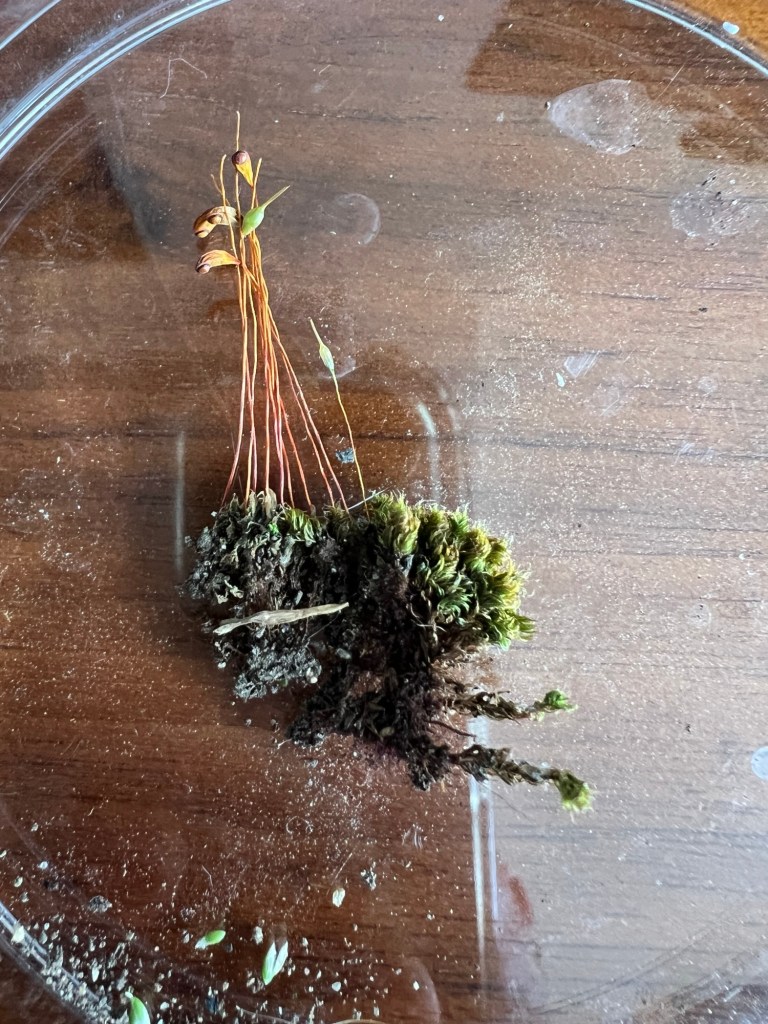
There are just 14 questions for the acrocarps, so it doesn’t feel at all daunting. I have been watching this cushion grow on this step crevice for a while and decided that I would find out which moss it is. As I read through the questions, I was learning. The descriptions and accompanying pictures help to make decisions whether your answer is YES or NO. At question 3, it asks if it has ‘whiskers’? I thought mine, using the hand lens, might have very short whiskers, so I went to Q4 and wondered if it might be Capillary Thread-moss (Phychostomum capillare). The leaves are described as having a distinctive heart shape and a kiss-curl at the tip. I wasn’t convinced that mine did, so I ventured onwards. However, when I got to Q6, I realised that perhaps it was in fact Capillary Thread-moss (Phychostomum capillare) as the description states it grows on hard surfaces, the sporophytes are often present (hello- you can see the orange beauties) and the dry version was tightly spiralled. The doubt I had were that it sates the sporophytes turn brown and mine appear to be bright orange. I did read on through the options, to Q14 and settled back on the best description as the Capillary Thread-moss (Phychostomum capillare).
The pleurocarp
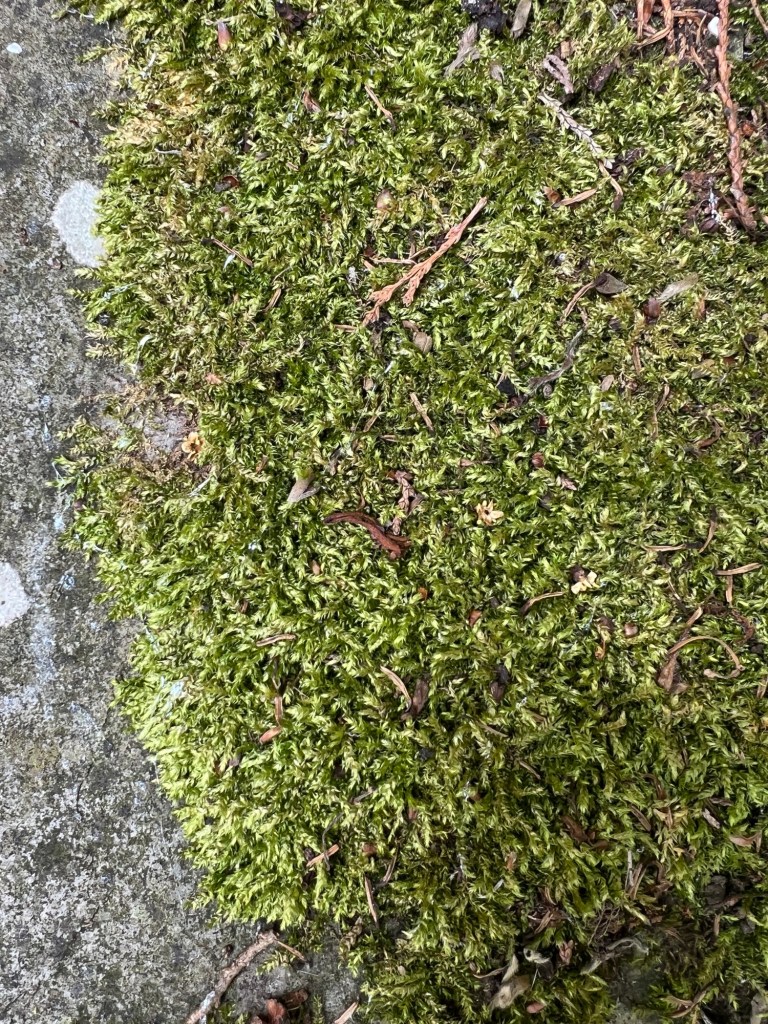
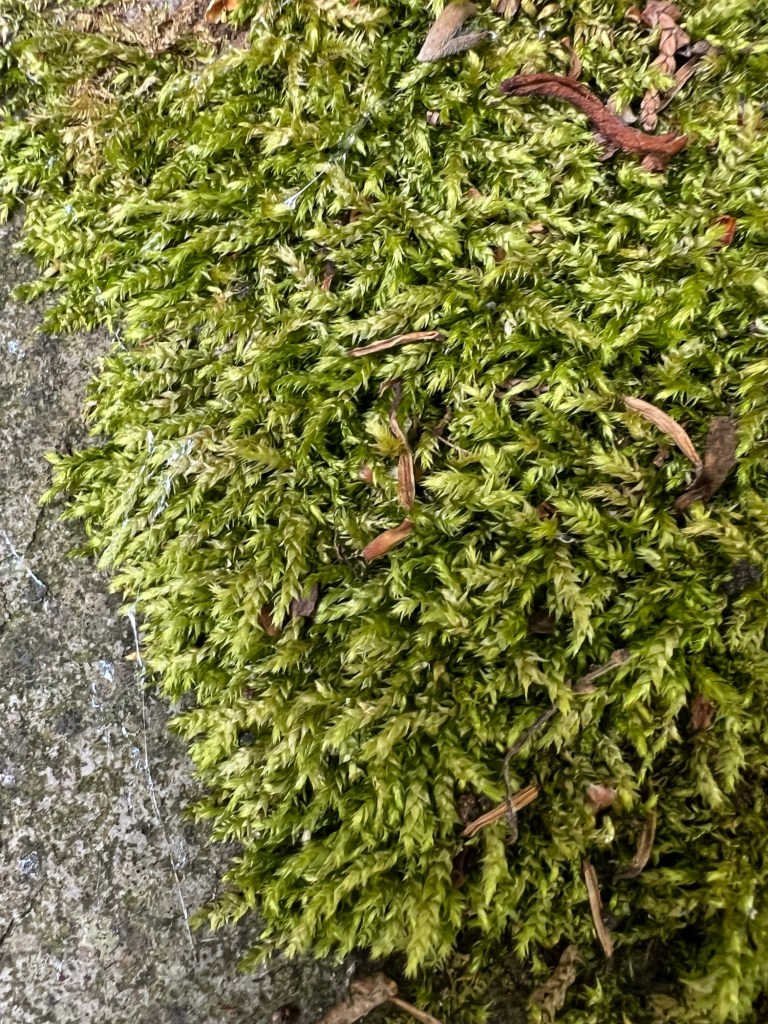
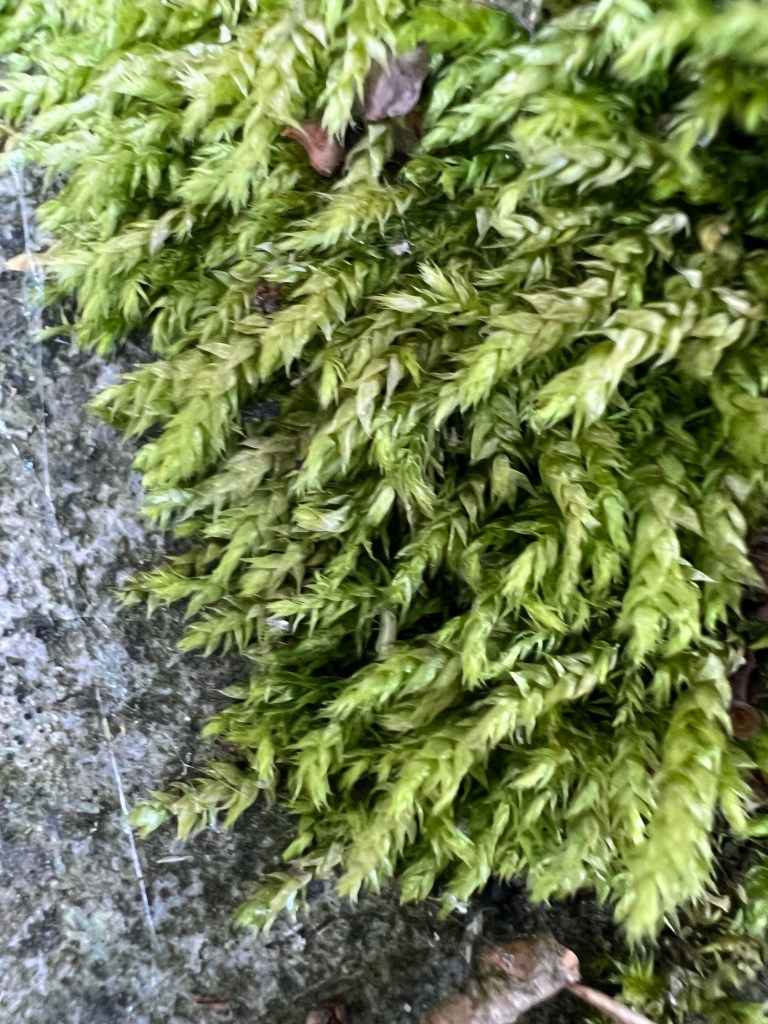
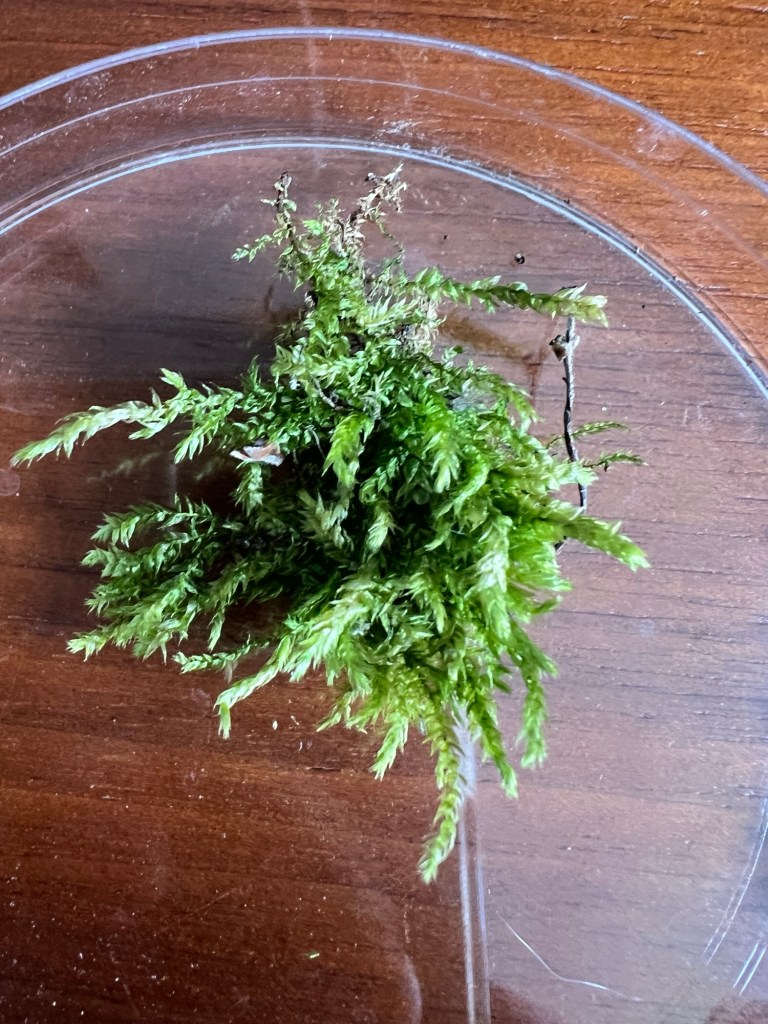
This pleurocarp grows in front of my shed on paving slabs. It’s there all season. So I went to the pleurocarp section. I was confident that it was a mat, branching form. The book section starts with some pleurocarp specific pointers. From this I decided that my sample was one-pinnate (has one branch in its growth form). There are just twelve questions in this section and I wasn’t getting anywhere much until Question 12! I did a lot of umming and ahhing along the way, but I think I am fairly confident about this being Rough-stalked Feather-moss (Brachythecium rutabulum). Faith tells me that this is known as ‘Ordinary Moss’ and it lacks distinguishing features! I did a touch check and it did indeed feel ‘undeniably rough’.
The verdict
As the saying goes, it’s the journey, not the destination that is important. This holds true for this book, as the hour I spent attempting to identify two mosses with Faith’s book taught me more than perhaps reading a heavy text book. These are my take homes:
Enjoy the journey – using the book to identify these two mosses was a helpful journey. When I had doubts, I read on. Then sometimes flipped back. Each time, with more careful reading, Faith’s knowledge and non-technical language helped me fine-tune my identification. I learnt about other mosses along the way and as I find more, I might be able to identify them with more certainty.
Become comfortable with uncertainty – clearly the 763 species of mosses described in Britain and Ireland cannot be captured in Faith’s book. That is not the purpose. The ‘umming and ahhing’ I did along the journey is part of the process. Comparing, contrasting, making sense of new terms.
Celebrate the small steps – Faith gently introduces us to moss identification in this little book. In the final section, she guides the reader with ‘What next’ – where to find mosses, which books to read and how to take photos. I did go to my own copy of the British Bryological Society’s Mosses and Liverworts of Britain and Ireland a field guide, to help verify my identifications. However, I often feel with mosses you need an experienced expert with you. Faith’s book is the next best thing for us starting out on our moss identification adventures.
I’ve written a blog previously about my favourite moss books.

