Sunday 12 April 2026
The Quekett Microscopical Society
I explained that how we understand what we see is shaped by our assumptions. I started with a situation where a member of the public at the New Scientist Live event last year had asked me “What are tardigrades for?” My immediate response was that they are not ‘for’ anything, they are just tardigrades. But then I realised that a lot of people do have the assumption that the natural world is ‘for’ us humans. Then I went to the Linnean Society of London’s Queer Natural History Symposium in February this year where I started to question that what we perceive as normal actually hinders our understanding of the natural world.
What changed when nothing changed
Amongst all the wonderful sessions for World Microscopy Day, we looked a techniques – physical ways of seeing the microscopic world. Whether it is through different lenses, different types of light, manipulation of light or using electrons instead of light, we changed what we saw by changing what we were looking through or with.
I tried something unusual, a focus on philosophy of science, for my World Microscopy Day Moss Safari presentation.
We didn’t move between slides. We didn’t look for new organisms. We stayed.
With one bdelloid rotifer.
At first glance, that might sound limiting. In practice, it turned out to be one of the richest things I’ve done. Because instead of changing what we looked at, we changed how we looked.
Five times.
What emerged was not a better understanding of the rotifer, but a clearer sense that seeing is never neutral.
Lens 1: Identifying
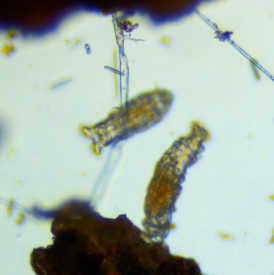
What is it?
We began in the most familiar place.
We named it. A bdelloid rotifer. We noticed its shape, its corona, it’s toes, its jaws. The way it anchored and stretched. We described it as accurately as we could.
In this mode, the rotifer becomes an object of knowledge. Something stable, recognisable, classifiable.
This is the power of representation. It allows us to organise the world, to communicate, to build knowledge.
But it also carries an assumption. That what matters most about the rotifer is what it is. In natural sciences we use taxonomy to classify organisms so that others can recognise the same species when they see it. If we have seen Bdelloid rotifers before, we know what to look for – the shape, the behaviour, the defining characteristics. If we haven’t, we are curious as we recognise that we haven’t seen something like that before.
As Donna Haraway reminds us, even this “objective” view is not neutral. It comes from somewhere. It reflects particular priorities.
And already, something else is slipping out of view.
Lens 2: Following
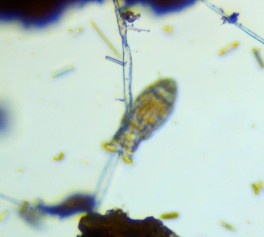
What is it doing?
We stayed with the same rotifer, but asked a different question.
Not what is it, but what is it doing?
Now the rotifer became movement. Feeding. Contracting. Extending. Turning. Pausing. Starting again.
It was no longer a fixed object. It was an unfolding process.
This shift feels small, but it matters. We begin to see time. We begin to see activity.
But there is still a boundary we cannot cross.
As Thomas Nagel famously argued, observing behaviour does not tell us what it is like to be that organism. We can describe what the rotifer does, but not what it experiences.
There is a gap between action and experience. And it remains.
Lens 3: Relating
What is it part of?
Then we widened the frame.
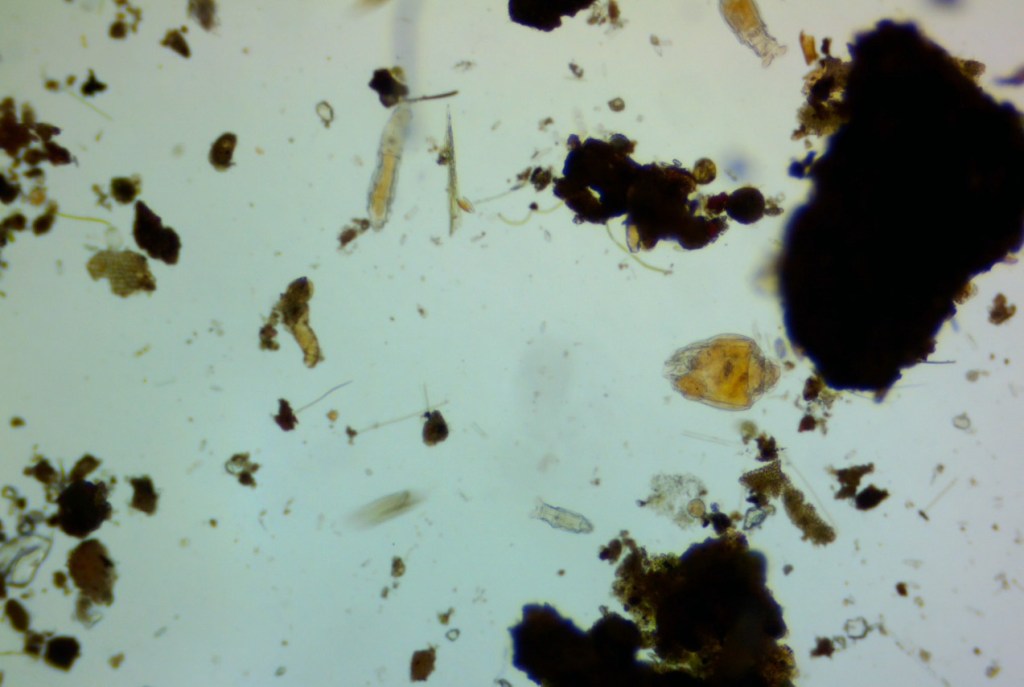
The rotifer did not disappear, but it stopped being the centre of everything. We noticed the water around it. The debris. The moss structures. Other organisms drifting in and out of view.
Now the rotifer became something else again. Not an isolated being, but something that emerges through its relationships. Its movement depended on water films. Its feeding depended on what passed nearby. Its presence reshaped the space around it.
Those with an ecological training will see it as part of the wider ecosystem, its place in a food chain or web, it’s role in carbon and nitrogen cycling, but there is a something even more stark about the interdependence and interrelationships we look for.
This is where the idea of relational ontology becomes tangible. The suggestion, developed by thinkers like Karen Barad, that things do not exist independently and then interact. They become through interaction.
At this scale, individuality starts to blur. The rotifer is still there, but it is no longer fully separable from its surroundings.
Lens 4: Questioning
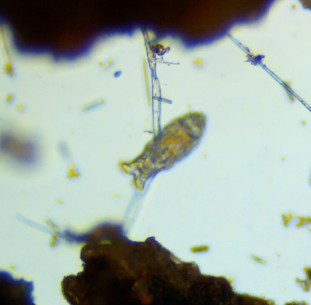
What can we not know?
At this point, it becomes tempting to explain. Why is it moving like that? What is it sensing? What is it “trying” to do?
Instead, we paused.
Even with magnification, we could not see intention. We could not access experience. We could not know how the rotifer’s world appears to it.
This is not a limitation of skill. It is a limitation of position.
We are always looking from somewhere. Through an instrument. At a particular scale. With particular assumptions.
As Donna Haraway argues, all knowledge is situated.
Not knowing becomes part of the method.
Lens 5: Witnessing
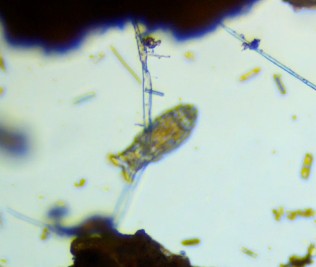
What if we stop explaining?
Finally, we took one more step.
We stopped asking questions.
No more what is it. No more what is it doing. No more what does it mean.
We simply watched.
The rotifer continued. Feeding. Moving. Pausing. Existing entirely independently of our understanding.
This is where the shift becomes ethical.
We move towards what Édouard Glissant calls opacity, the idea that not everything needs to be made fully knowable. We practise refusal, in the sense described by Mel Y. Chen, not forcing the organism into our frameworks of meaning. And we step away from teleology. The assumption that life must have a purpose we can define.
The rotifer does not need to make sense to us.
It simply continues.
I used the example of that we impose ‘norms’ such as the need for males and females to reproduce. These are meaningless to a rotifer: male, female, sexual reproduction. Rotifers just continue.
What changed?
Nothing about the rotifer changed.
But everything about our encounter with it did.
Each lens revealed something:
- Identification gave us structure and made us confront our prior knowledge and assumptions.
- Following gave us movement and our assumptions of what it might be doing.
- Relating gave us connection, recognising our ecological assumptions, but a deeper philosophical point that being is interacting.
- Questioning gave us humility, we don’t know everything, nor do we need to know.
- Witnessing gave us restraint, rotifers continue as they have been, as they are and how the will be with or without human observation, description or understanding.
And each lens also left something out.
Why this matters
This was not just an exercise in observation.
It was a reminder that what we see depends on how we look. And perhaps more importantly there is no single correct way of seeing.
In Moss Safari, we often begin by trying to understand. But sometimes, the most meaningful shift is not towards deeper explanation. It is towards different attention.
Questions and thanks
Thank you to the 60 or so viewers who indulged my musings. I really didn’t know how this would be received. It also felt a safe space to share my forming thoughts, knowing that I am far from finished in my thinking.
I was pleased with the responses at the time and the follow up questions. Some said they didn’t quite follow my thinking, but for others it raised questions about ethics, how we present our passion and knowledge of microscopy to others. It touched on if we treat these organisms as beings, what does that mean for how we observe them and treat them after we have observed them. Follow up messages called for more philosophical and ethical discussions about microscopy and others just an intellectual curiosity that there is more than one way of seeing down a microscope.
Let me know your thoughts in the comments.
If you are an amateur or professional microscopist for a small annual fee you can benefit from being a member of the Quekett Microscopy Club. They usually do far more practical stuff than this! Sign up here.

