Wednesday 22 April 2026
April’s Moss Safari Monthly session took a step back from individual organisms and asked a bigger, more powerful question:
What happens when we look at moss as a whole ecosystem?
The theme for this session was simple but profound: everything is connected.
From Individuals to Interactions
In previous sessions, we met the stars of the show, the Microscopic Big Five. This time, the focus shifted from who is there to how organisms interact, how they share space, and how they depend on one another.
This is where Moss Safari becomes something deeper than observation. It becomes ecology.
Getting Started: Sampling the Micro-World
We began, as always, with a practical approach.
Using a pipette and a dimple slide, I demonstrated how to take a moss sample and prepare it for observation under the microscope. It is a simple technique, but it opens the door to an entire hidden world.
In a typical sample, you might encounter nematodes, rotifers, tardigrades, mites, and sometimes gastrotrichs, although gastrotrichs are much more likely to appear in sediment-rich samples than in a straightforward moss squeeze.
But this session was not about listing organisms. It was about what they are doing.
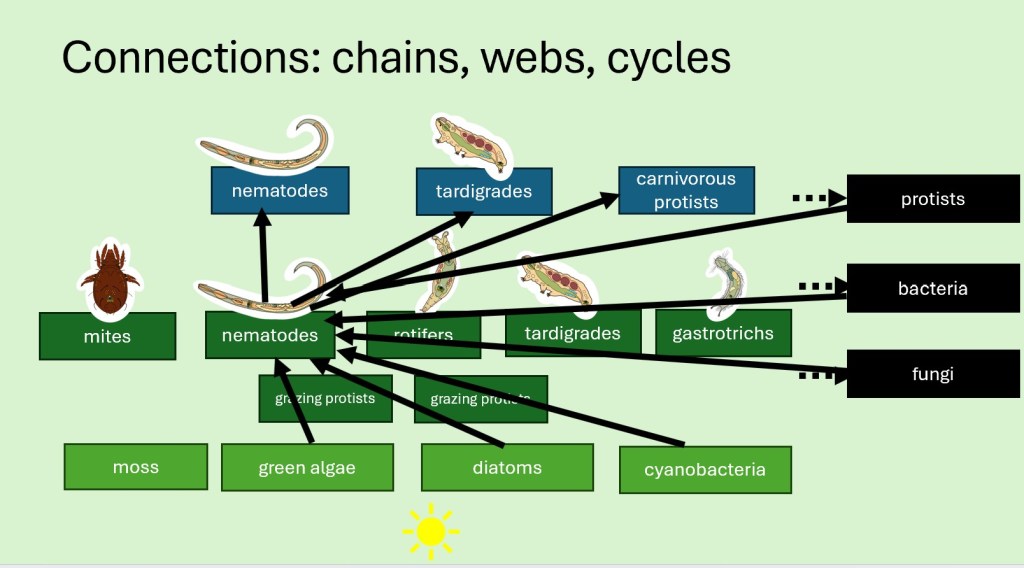
The Moss Food Web in Miniature
Inside a cushion of moss, a whole ecological network is constantly in motion.
Plants capture energy from sunlight. Dead material accumulates. Decomposers break it down. Herbivores and micro-predators feed, move, grow, reproduce, and eventually become part of the cycle themselves.
Nothing is wasted. Everything cycles.
We explored how carbon moves through this system, continuously recycled through life, death, and decay. Even at this microscopic scale, the same ecological principles apply as in forests, oceans, and the entire planet.
Life Under the Lens
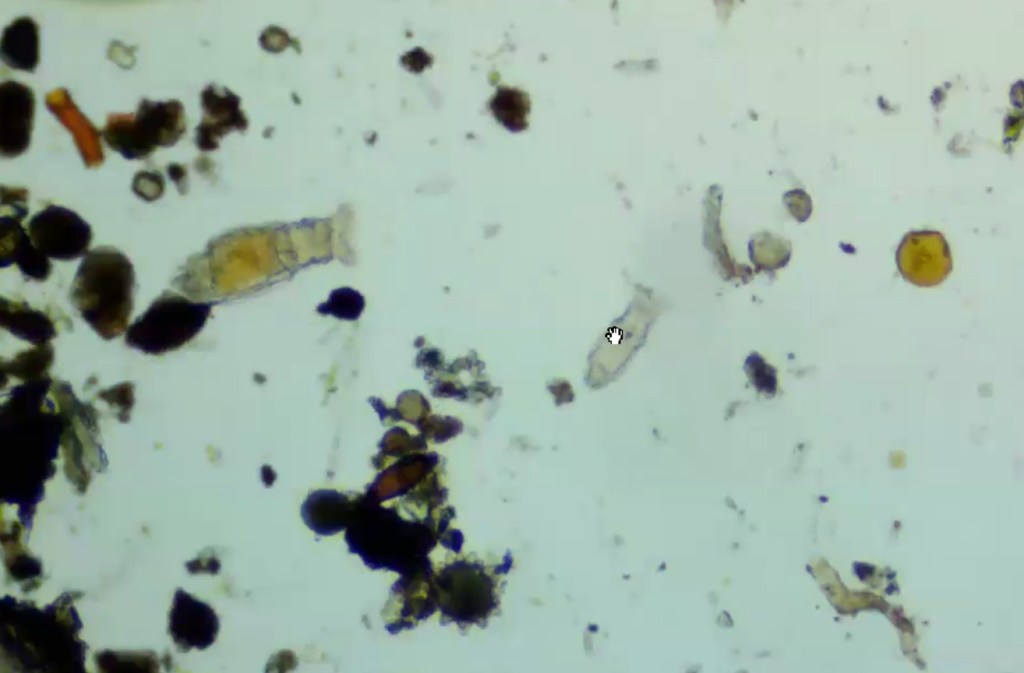
As we explored the samples together, a remarkable variety of life appeared.
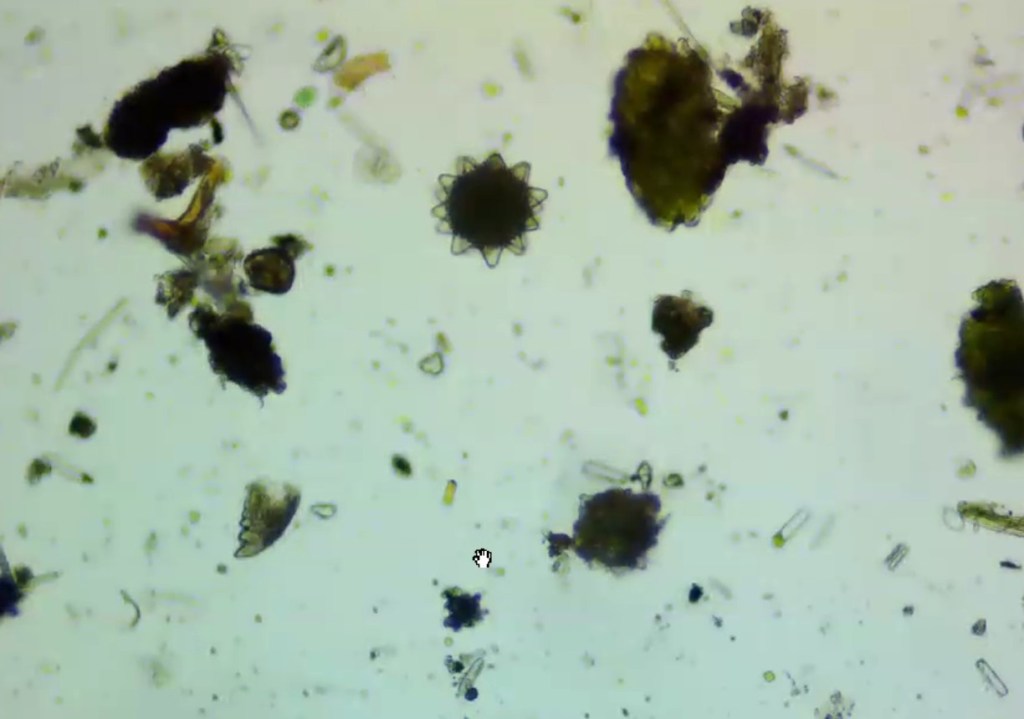
There were rotifers feeding and contracting rhythmically, diatoms with their beautiful geometric forms, tardigrade eggs hinting at the next generation, cyanobacteria quietly photosynthesising, and an Arcella testate amoeba carrying its tiny shell.
Each organism tells a story, but together they tell a much bigger one.
Tardigrades: Small, Tough, and Extraordinary
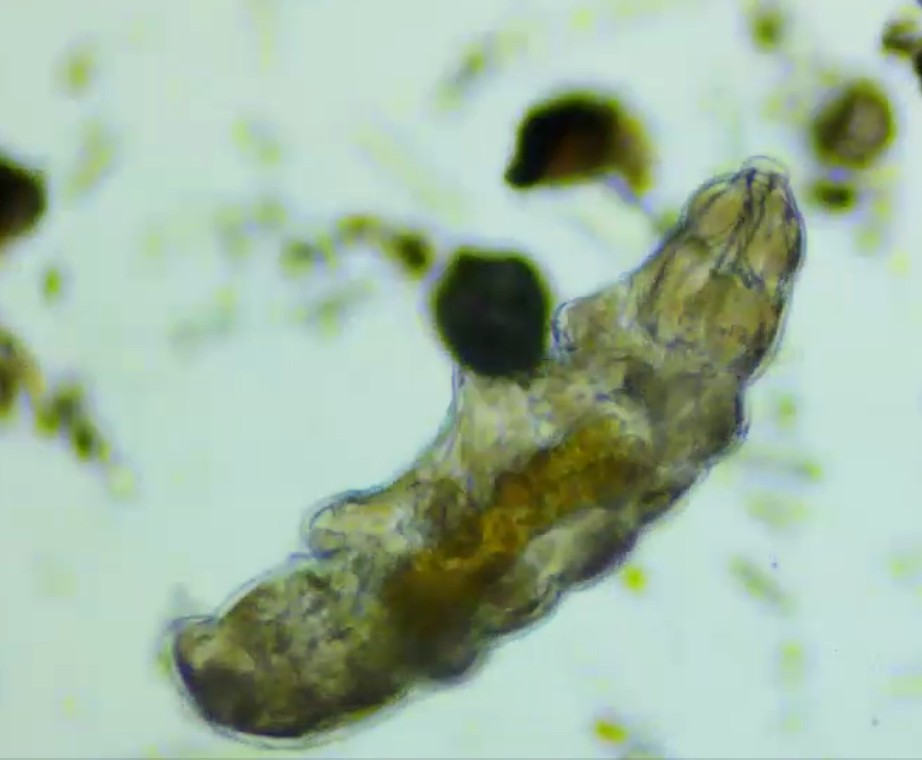
We spent some time focusing on one of the favourites: the tardigrade.
Under the microscope, we observed an active tardigrade with eight stubby legs, tiny claws, and needle-like mouthparts used to pierce and feed.
We also discussed the extraordinary resilience of tardigrades, including a newly described Japanese species capable of forming a highly resistant “death ball” state. It was a striking example of just how far microscopic life can push the limits of survival.
Despite their toughness, tardigrades are beautifully simple. They have around a thousand cells and no specialised respiratory system. Instead, oxygen diffuses through their bodies from the surrounding water.
They are both fragile and incredibly resilient. A fascinating contradiction.
Invisible Threats: Microplastics
No ecological discussion is complete without acknowledging human impact.
We touched on microplastics and their growing presence in microscopic ecosystems. These tiny particles can move through food chains, affecting organisms at many different levels.
And this is where the theme of the session becomes unavoidable:
We are part of this system too.
What happens in moss does not stay in moss.
A Final Reflection: The Woodland Web
We ended by zooming out again.
From individual organisms, to food webs, to the wider woodland system, the same principle runs through everything.
Fungi, in particular, play a crucial role in connecting different parts of the woodland web. They recycle nutrients, support plant life, and help hold ecosystems together.
Life is not a collection of separate parts. It is a network of relationships.
What Participants Said
It was fantastic to see such positive responses from those who joined the session, with many highlighting both the sense of discovery and the deeper ecological understanding.
“Seeing life under the microscope.”
“Obviously, seeing the tardigrade. I’m always excited to see them!”
For many, this was a completely new experience, opening up an unseen world:
“This was my first Moss Safari, all very new and interesting.”
“Lots, a whole new learning experience.”
The theme of connection clearly resonated, helping participants rethink how they see the natural world:
“Really eye opening… when we look at moss we don’t think about everything interacting.”
“I liked that the session focused on food webs and how everything links together.”
“I knew things were connected underground, but not at this level.”
Overall, participants valued both the science and the sense of wonder, with one noting:
“Not knowing a lot about moss or the organisms made it even more interesting.”
Encouragingly, most said they would be very likely to recommend Moss Safari to others.
What Next?
The next Moss Safari Monthly session will take place on:
Tuesday 20th May, 7–8pm BST
Theme: Knowing Our Limits
Final Thoughts
This session was a reminder that Moss Safari is not just about discovering tiny creatures.
It is about seeing the world differently.
When you look closely at moss, you begin to understand something much bigger: connection, dependency, and the delicate balance of life.
And once you see it, you cannot unsee it.
If you joined the session, thank you for being part of it. And if you are new here, perhaps it is time to take a closer look at the moss around you.

