Wednesday 1st July 2026
The fifth and final Moss Safari Monthly arrived in June, bringing this little series of live microscope safaris to a close. For five months, we have returned to moss, squeezed out a few drops of water, placed them onto a dimple slide, and looked for the small lives moving through it.
Each month had a slightly different focus. We have noticed. We have named. We have described. We have asked questions. But for this final session, I wanted to do something a little different.
This time, the focus was witnessing.
Not collecting. Not measuring. Not needing to identify everything. Not forcing the living world to become a set of answers.
Just watching.
Watching Without Taking
There is something wonderfully freeing about looking through a microscope without feeling that everything has to be solved.
Of course, naming things matters. Identification helps us notice patterns. It helps us learn. It helps us communicate. In Moss Safari, we often look for the Microscopic Big Five: oribatid mites, nematodes, rotifers, tardigrades and gastrotrichs. They are the charismatic microfauna of the moss world, all usually less than one millimetre long, but large enough to become familiar under a microscope.
But moss contains far more than the Big Five. It holds algae, fungi, bacteria, testate amoebae, ciliates, air bubbles, debris, leaf fragments, rhizoids, eggs, resting bodies, movement and stillness. Some things can be named quickly. Some things cannot. Some things resist being sorted into a neat category.
And that is fine.
In this final session, the question was not only “What is it?” but also:
- What is happening?
- What can I notice?
- What is changing?
- What does it mean to observe respectfully?
Deep Time in a Drop of Moss Water
At the beginning of the session, we took a moment to think about geological time.
The organisms we meet in moss belong to ancient lineages. Long before humans appeared, long before mammals became dominant, long before flowering plants filled the landscape, small animals and microorganisms were already finding ways to survive.
Moss itself connects us to deep time. It is a simple plant, but not a primitive one in the sense of being unsuccessful. Mosses have survived by doing something extraordinarily effective: staying small, staying close to the surface, tolerating extremes, and waiting.
The animals that live with moss have their own survival strategies. Many of them can endure drying, cold, and long periods when conditions are not suitable for active life. In this session, because the moss sample was dry and rather battered after months of use, survival became one of the main stories.
And, wonderfully, the moss still had life to show us.
A Sleeping Rotifer
One of the first members of the Big Five we found was a rotifer.
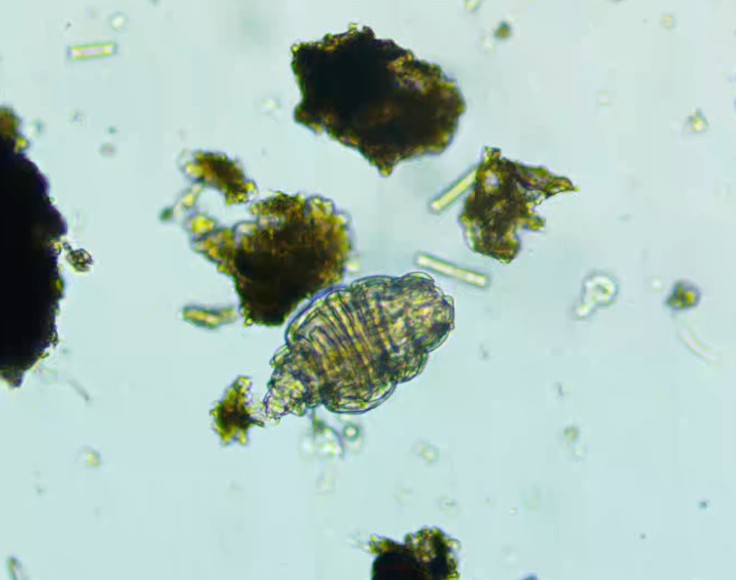
She was curled up, quiet and still. Her head and foot were tucked in, her body folded into a compact shape. At first glance, she might have looked dead. But she was not dead. She was waiting.
Rotifers can enter cryptobiosis, a remarkable state where their life processes slow dramatically. When conditions become too dry or too cold, they can curl up and pause their life cycle. When water returns, they can wake again.
There is something beautiful about that. A tiny animal, hidden in moss, waiting for the world to become possible again.
Later in the session, we found another rotifer beginning to wake. Slowly, she stretched out. Her toes appeared. Her head moved. Her jaws became visible. The animal that had seemed like a curled speck of debris became recognisably alive.
This is one of the joys of Moss Safari: the moment when stillness becomes behaviour.
A Curled Nematode
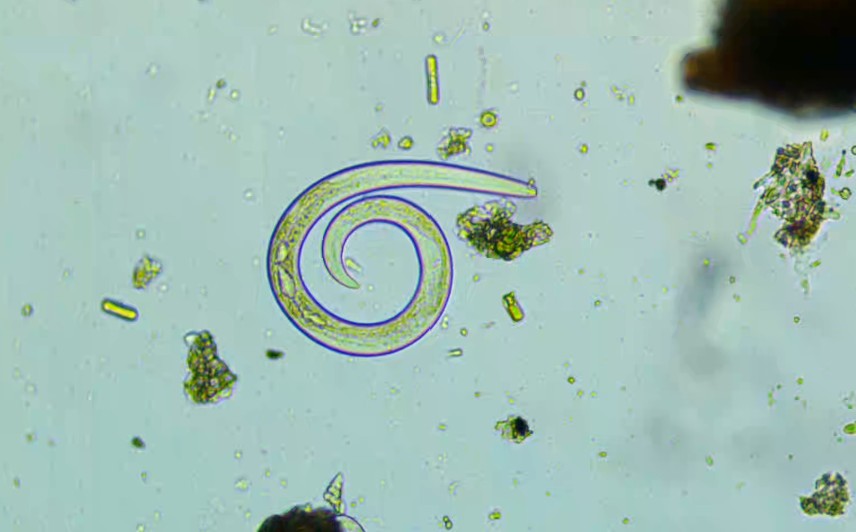
The second of the Big Five to appear was a nematode worm.
It was curled up, another sign of the dry conditions in the moss. Nematodes can also survive difficult environmental conditions by reducing water loss and entering resistant states. Under the microscope, we could see the worm-like body, the mouth end, the tail end, and even some of the internal structure.
Because the moss had been so dry, I was genuinely pleased to find it. Sometimes a sample is teeming with movement. Sometimes it is quieter, more cryptic. In this session, the quieter signs mattered. The curled shapes, resting bodies and slow awakenings told the story of life under pressure.
A moss safari is not always about spectacle. Sometimes it is about patience.
Testate Amoebae and Tiny Shells
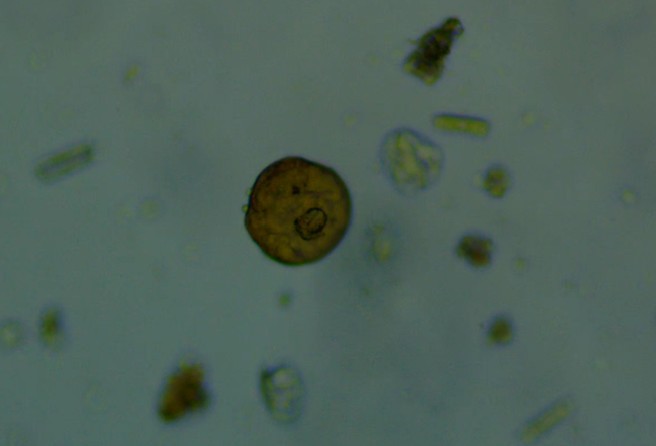
We also found testate amoebae, sometimes called shelled amoebae.
These are single-celled organisms that build or occupy tiny shells, moving through the moss and feeding using pseudopods. Some of the shells were empty, or at least no occupant was visible. One of my favourites appeared too: the golden, circular form that I often think of as a “lucky golden penny”.
The shells of testate amoebae are easy to overlook if you are only hunting for movement. But when you slow down, they become beautiful in their own right. Their shapes are varied, architectural and often surprisingly delicate.
They are a reminder that life in moss is not just about the obvious animals. The single-celled world is vast, active and deeply important.
A Feeding Rotifer
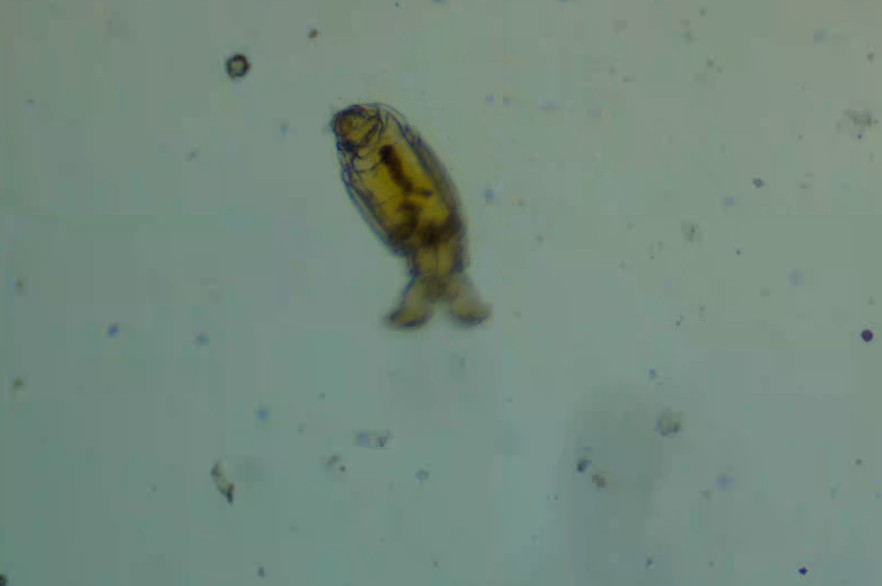
One of the highlights of the session was finding a rotifer feeding.
This one was fully active, attached by her toes, with her wheel organs open. These ciliated structures beat rapidly, drawing food particles towards the mouth. Under the microscope, it looked as though the water around her was being stirred.
This is where observation becomes mesmerising. You can know the explanation, but still be struck by the living movement of it: the head moving, the jaws working, the body anchoring and stretching. A rotifer feeding is a tiny engine of life.
Bdelloid rotifers are especially fascinating. They are famous for their ability to survive drying and for their unusual reproductive biology. In the session, we talked about them as “Sleeping Beauties” because of their extraordinary capacity to pause, wait, and resume life when conditions improve.
The Bonus Slide
Near the end, with a few minutes left, we made one final bonus slide.
I am glad we did.
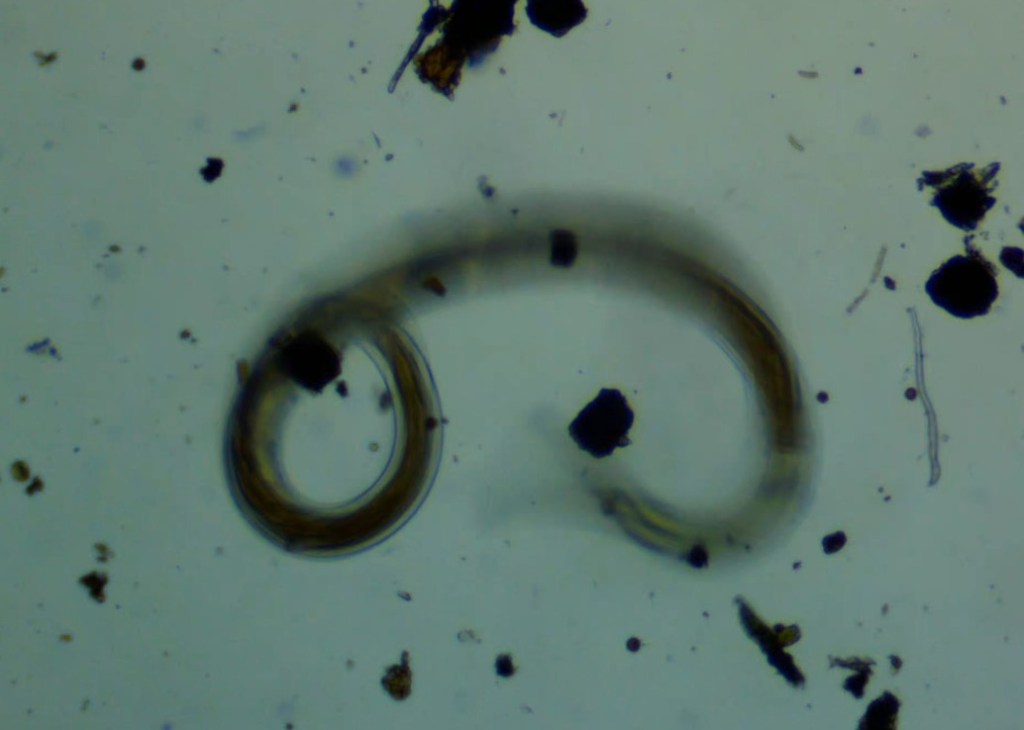
Almost immediately, we found another rotifer, then a large adult nematode thrashing through the slide. It was much more active than the curled nematode earlier, and inside the body we could see dark rounded structures that looked like eggs. Earlier we had seen young nematodes, so this adult connected the story: the moss was not just holding survivors, but a continuing life cycle.
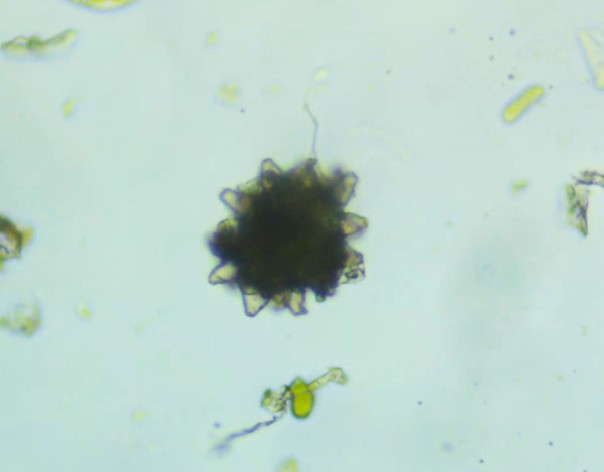
Then came a lovely final gift: a star-shaped tardigrade egg.
We did not find an adult tardigrade in this session, but the egg was enough to show that they were there. It was also a pleasing echo of the first Moss Safari Monthly, where we had also found a tardigrade egg. The series began and ended with the possibility of a tardigrade.
There is something poetic about that.
Life Carries On
The strongest thought I was left with is this: life in moss carries on regardless of us.
It does not need to be watched to be real. It does not need to be understood to matter. It does not need to be named to have its own integrity.
The rotifer wakes because water has returned. The nematode coils, thrashes, feeds and reproduces. The testate amoeba leaves behind its shell. The tardigrade egg waits. The algae photosynthesise. Single-celled organisms gather around oxygen bubbles. A whole world continues, whether we are paying attention or not.
That, for me, is one of the deepest lessons of microscopy. It shifts the human gaze. We are not always the centre of the story. Sometimes we are simply visitors.
The Value of Witnessing
To witness is not to be passive. It is an active, respectful kind of attention.
It asks us to slow down.
It asks us to accept uncertainty.
It asks us to let another form of life be itself.
For younger explorers, this might mean asking: can something be important even if we do not know why? What happens when we stop looking?
For deeper thinkers, it might mean asking: does everything need to make sense to matter? What does respectful observation look like?
These are scientific questions, but they are also ethical ones. They shape how we meet the living world.
Thank You
This final session brings the first Moss Safari Monthly series to a close. Across the five months, we have explored the same small world in different ways, and I am grateful to everyone who came along live, watched the recordings, asked questions, noticed details, and shared the experience.
Moss is easy to walk past. It is small, familiar and often treated as background. But under a microscope, it becomes a landscape full of movement, survival, beauty and surprise.
So, as ever: notice some moss. Add water. Look closely.
You may not find everything. You may not know what everything is. You may not get all the answers.
But you might witness something extraordinary.
Free Moss Safari resources and identification sheets are available at:
mosssafari.com
Follow Moss Safari for more microscopic adventures in moss, water and the hidden world beneath our feet.

