Celebrate Antonie van Leeuwenhoek Day – 7th September
Did you know that the 7th of September marks Antonie van Leeuwenhoek Day? It’s the perfect opportunity for teachers to inspire pupils with the story of the “Father of Microbiology” and spark curiosity about the invisible world all around us. Here I offer a free primary and secondary resource to use in the classroom. Download it, use it, let me know how it goes!

Who was Antonie van Leeuwenhoek?
Antonie van Leeuwenhoek (1632–1723) was a Dutch linen draper turned pioneering microscopist. Using tiny glass bead lenses that he crafted himself, he built simple but powerful microscopes. With these, he became the first person to see and describe living bacteria, protozoa, blood cells, sperm cells, and even tiny aquatic creatures such as rotifers and nematodes.
His letters to the Royal Society in London amazed scientists of the day, revealing that a whole hidden universe teemed in a drop of pond water. For these discoveries, he is remembered as the Father of Microbiology.
We celebrate him every 7th September. We honour his curiosity. We encourage today’s learners to look more closely at the natural world.
I realised that I had a misconception about the contributions of van Leeuwenhoek and Robert Hooke in England. Robert Hooke had published Micrographia in 1665 that included magnified animals and plants, including the famous flea, but it was van Leeuwenhoek that first described living microorganisms using a his simple microscope, including bacteria which he called ‘animalcules’ and other single celled organisms.
Why this matters for your teaching
Antonie’s work connects directly with the National Curriculum in England:
- Primary Science:
- Working scientifically – observing closely, using simple equipment, and asking questions.
- Living things and their habitats – recognising the diversity of life and how organisms are classified.
- Animals, including humans – understanding cells, tissues, and the microscopic building blocks of life.
- Secondary Science:
- Biology: Cell biology – microscopes, cell structure, and the development of scientific ideas.
- Working scientifically – the importance of evidence, observation, and scientific enquiry.
- History of science – how Hooke and van Leeuwenhoek advanced microscopy and shaped modern biology.
Celebrating this day is a fantastic way to highlight not just science content but also the spirit of discovery.
Free Moss Safari resources for your classroom
To help you bring Antonie’s story to life, we’ve created two free downloadable activity sheets:
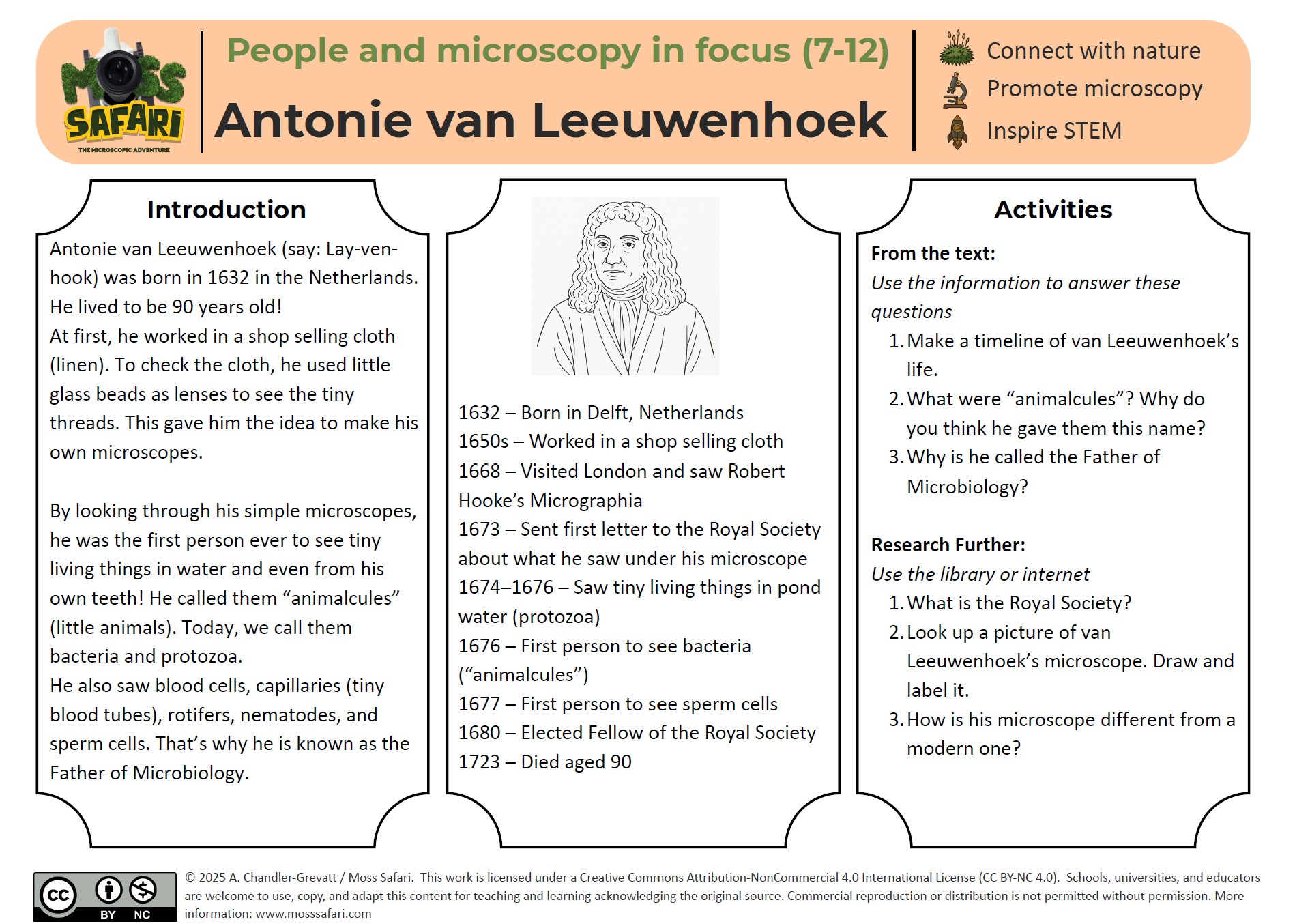
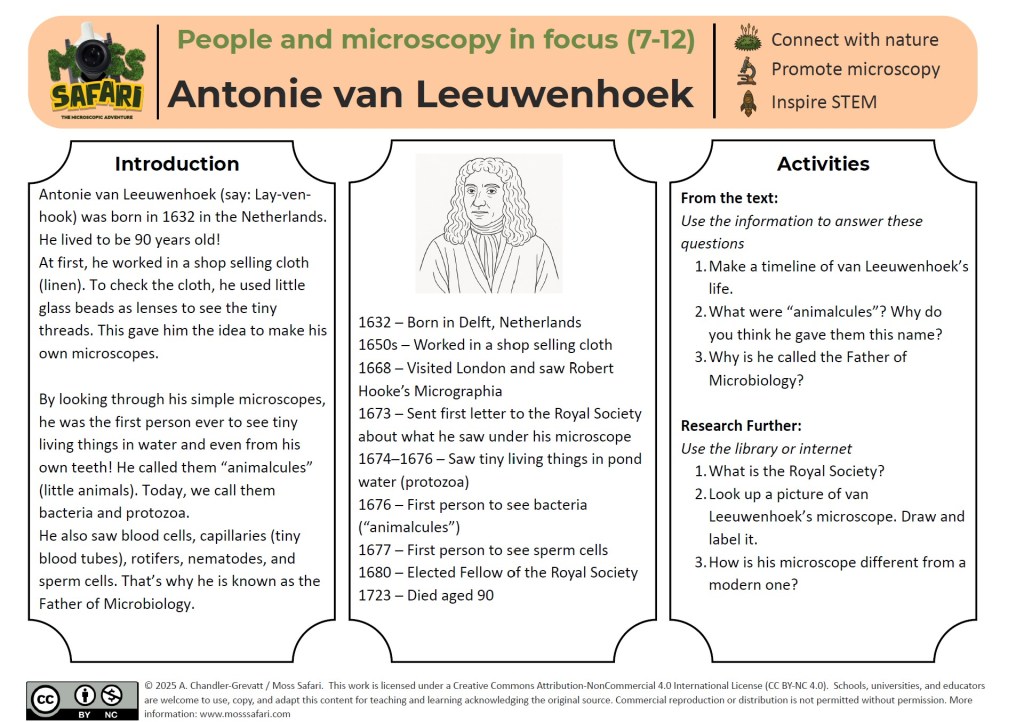
- Primary resource (ages 7–12) – pupils explore van Leeuwenhoek’s life, create a timeline, discover what “animalcules” were, and compare his microscope with modern ones.
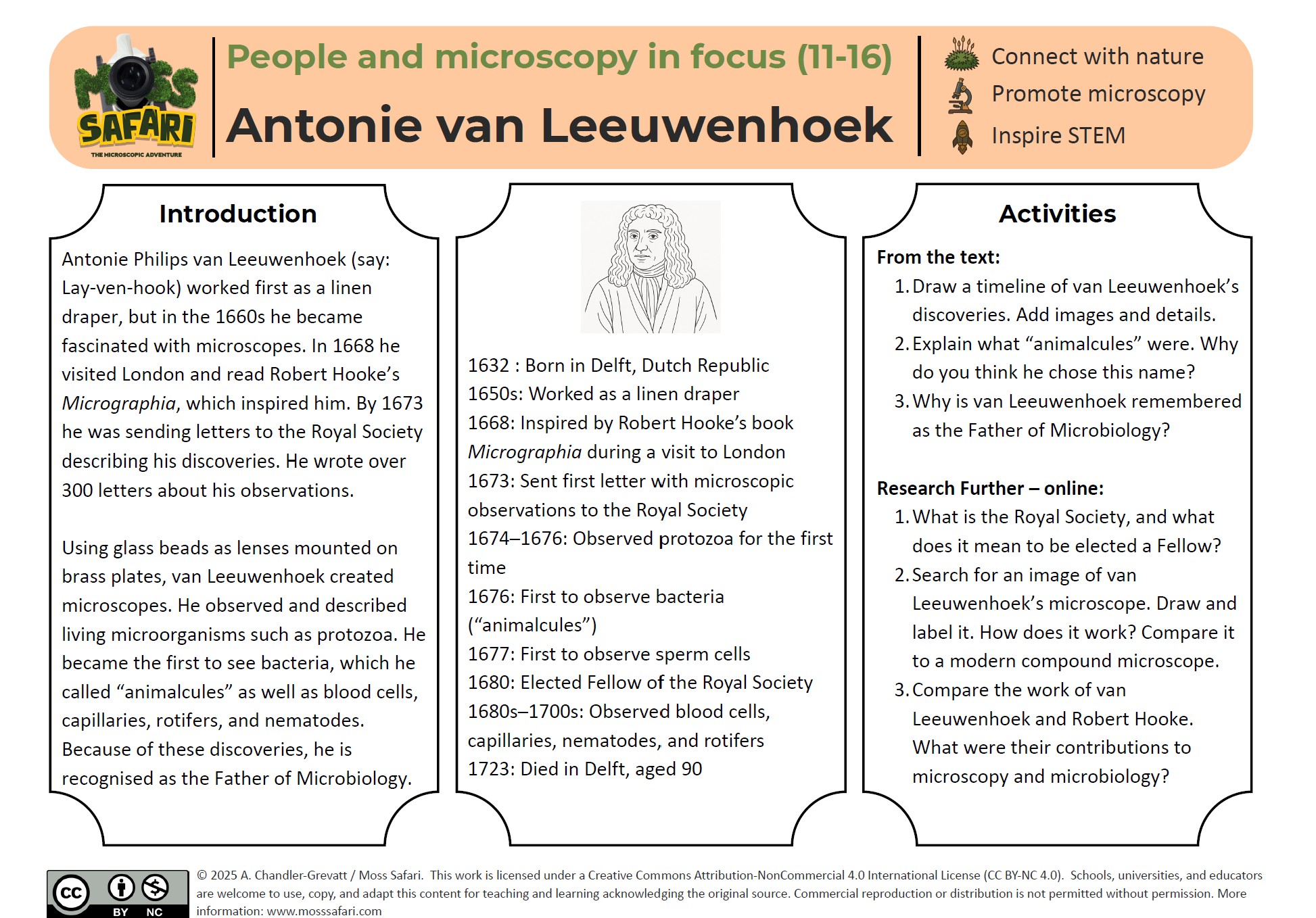
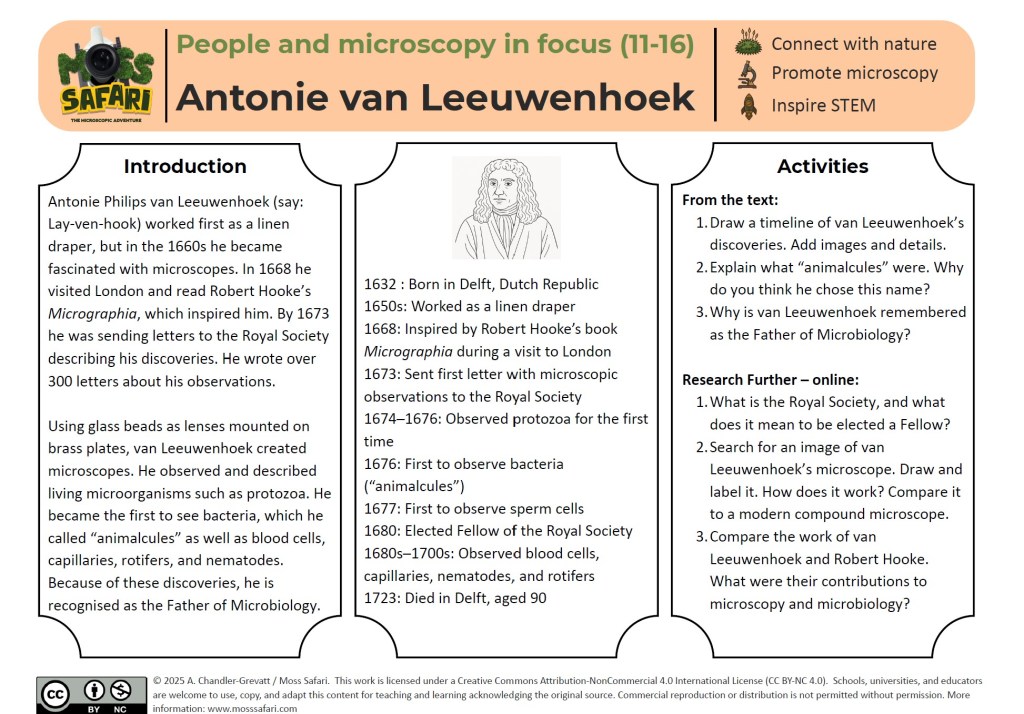
- Secondary resource (ages 11–16) – students draw a detailed timeline, research the Royal Society, compare Hooke and van Leeuwenhoek, and examine how microscopes have changed.
These resources can be used in lessons, for homework, or even as a cross-curricular link with history.
This could also be used to complement a Moss Safari. Imagine what van Leeuwenhoek would have been thinking as the first person to observe microorganisms in water. Draw and describe the organisms that you see
Share your feedback
We’d love to hear how you use these resources in your classroom. Did your pupils enjoy making their own timelines? Did they come up with imaginative explanations of “animalcules”? Your feedback will help us refine and create more free resources for teachers.
Download the resources, try them out, and let us know how your class responded in the comment box below!
If you’ve found this useful, take a look at how you can support Moss Safari further
Further links
BBC Radio 4 Extra Natural History Heroes
BBC History Antonie van Leeuwenhoek (1632 – 1723)
The Conversation: The 17th-century cloth merchant who discovered the vast realm of tiny microbes – an appreciation of Antonie van Leeuwenhoek
Lane, N., 2015. The unseen world: reflections on Leeuwenhoek (1677) ‘Concerning little animals’. Philosophical Transactions of the Royal Society B: Biological Sciences, 370(1666) Royal Society
 Moss Safari