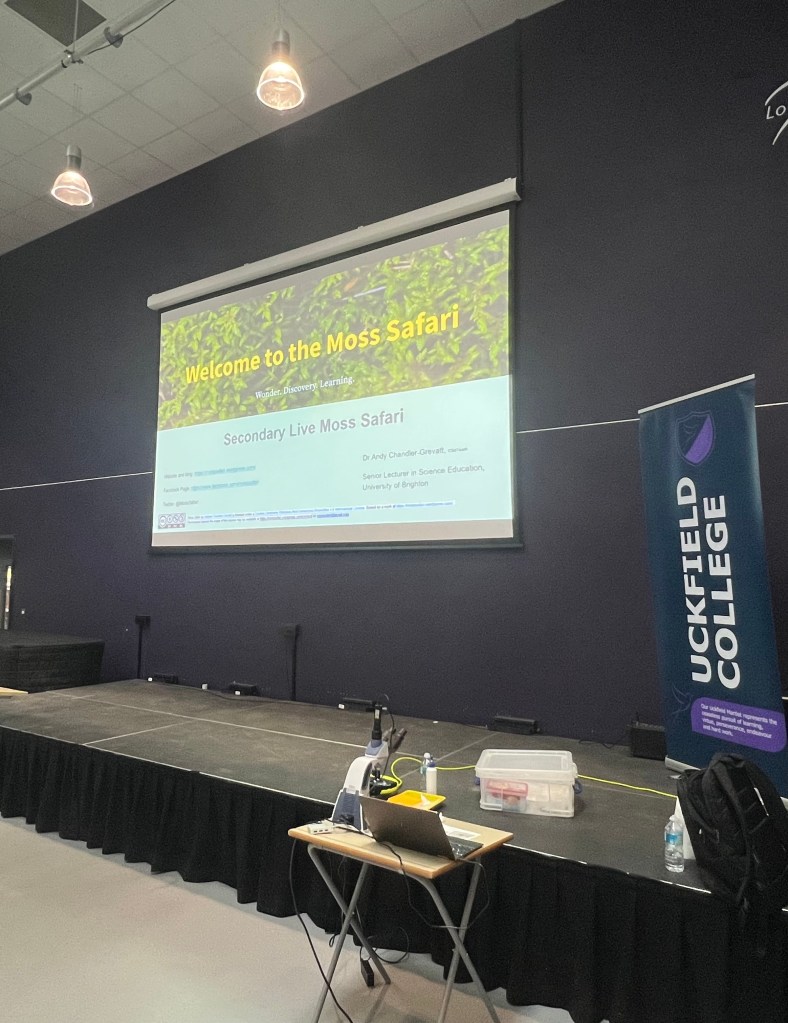
Moss Safari visited four classes of Triple Science (ages 14-16) students at Uckfield College on Tuesday 18th March 2023. The live Moss Safari took place in their auditorium, using the biggest screen that I have displayed a Moss Safari. The brief was to make links to the current GCSE and wow the students with Moss Safari to broaden their experiences of science. This group have had a series of sessions from outside speakers to broaden their experience of science.
What we saw
We managed to see two of the Big Five on just one slide. There were plenty of rotifers in various modes – resting, walking, swimming and feeding. We got some good views of their jaws and wheel organs. We saw two stationary tardigrades: one heterotardigrade (armoured) and one eutardigrade (soft). It was a shame we didn’t get a moving one. I told the audience about nematodes and moss mites in their absence.
Beyond the big five we saw some active diatoms, a few testate amoebae including a few Arcella. There were quite a few ciliates swimming around as well.
Students’ questions
The students were encouraged to ask questions at the end before filling out some online feedback. The questions included:
- How many types of tardigrade are there?
- Have I found a new species?
- Can the tardigrades see us?
- Would eating the moss/organisms harm you?
What did they think?
As with most of these school sessions, I have a captive audience. Not everyone wants to be there or has the slightest interest in Moss Safari. However, these are usually outnumbered by open, enthusiastic and interested students as you can see from the results in Table 1. The great thing is that you can capture students who had never really thought about moss or the world inside it.
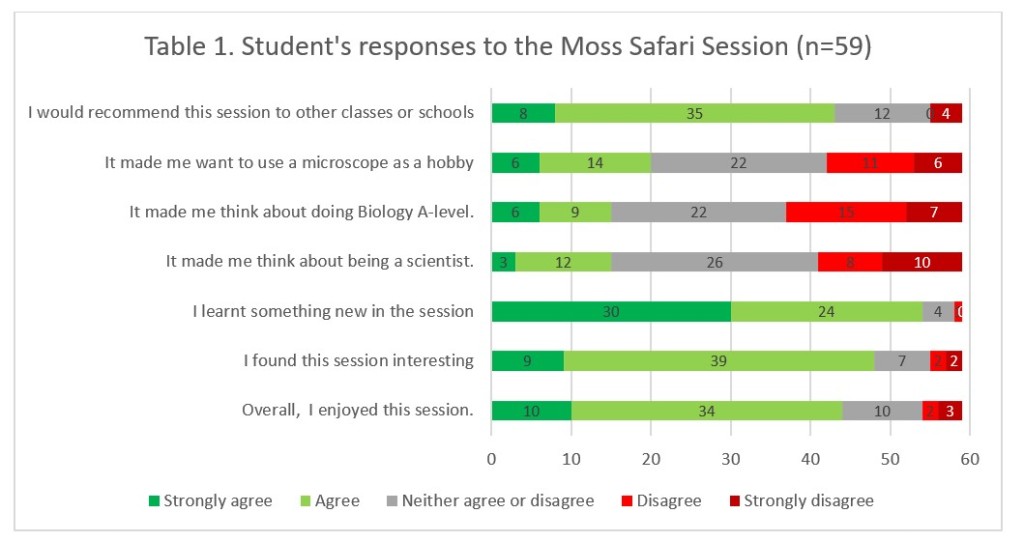
Note: 65 responses were collected, 6 of which did not give permission to publish their inputs, so total used is 59 responses.
Headlines are:
- 92% said that they learnt something new
- 81% found the session interesting
- 75% said that they enjoyed the session
- 73% would recommend the Moss Safari session to other schools/classes
One of the aims of Moss Safari is to help increase Science Capital: open opportunities for students to see themselves doing science as part of their lives, as a hobby or a career.
- 25% agreed that Moss Safari made them think about doing Biology A-level
- 25% agreed that Moss Safari made them think about being a scientist
- 34% agreed that Moss Safari made them want to use a microscope as a hobby
These results are very similar to the event I did last year at Durrington High School.
What did they learn?
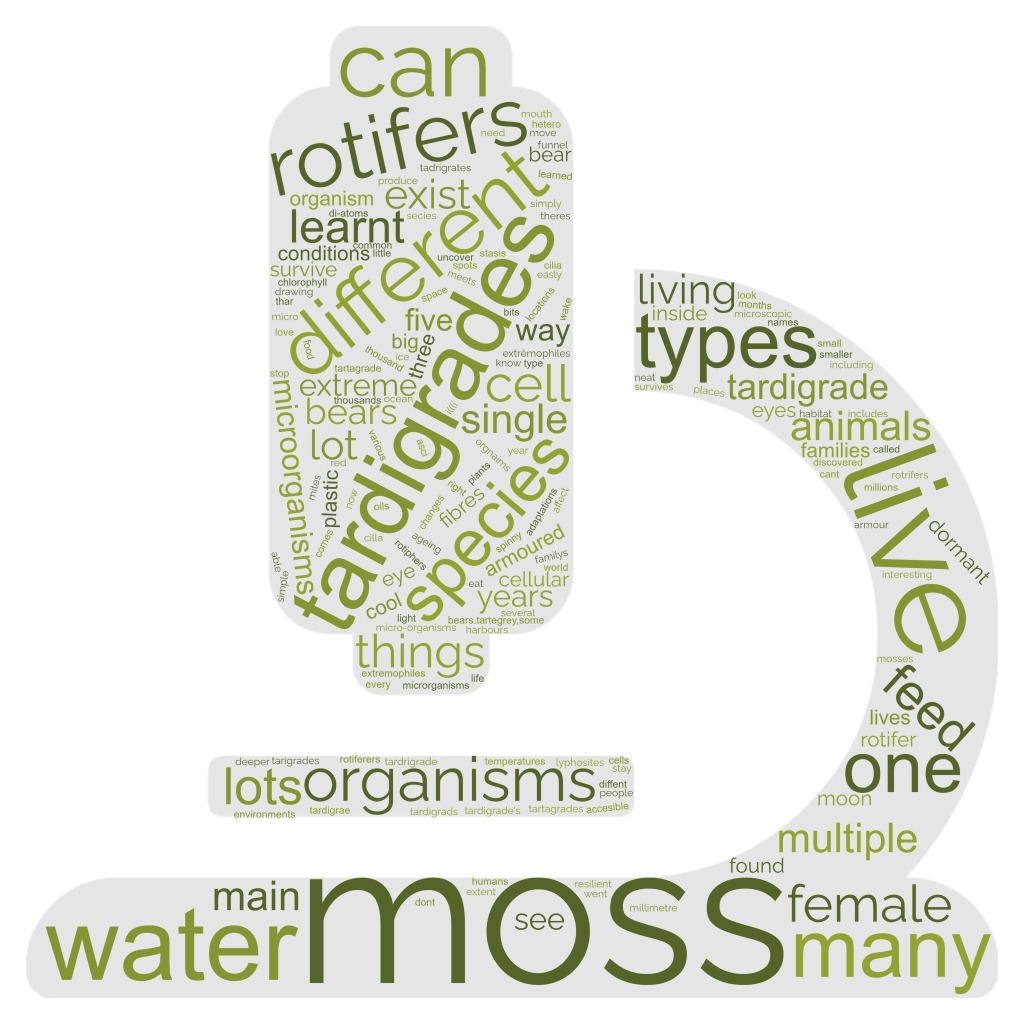
Students were asked to write three things that they learnt from the Moss Safari Session. The wordcloud (Figure 2) illustrates the key words that dominated those responses.
This is my favourite quote:
There is a lot more than meets the eye when it comes to simple things such as moss. I learned that there is a lot of interesting things that one can uncover when they simply look deeper.
What they were able to recall after the session was fascinating for example:
- There are millions of living organisms that we do not know, there are 5 main types of moss organisms, there are lots of one cellular organisms
- About tardigrades there are many different types and families. There are different types of chlorophyll.
- There are different types of tardigrade, rotifers have cilia to funnel food, rotifers can survive in ice for thousands of years.
- “rotifers can live thousand of years. water bears are very resilient. di-atoms produce oils”
In terms of curriculum links, a few mentioned extremophiles, several talked about the adaptations of the microorganisms and others made links to chlorophyll, unicellular organisms, eyes and individual species.
What did they like?
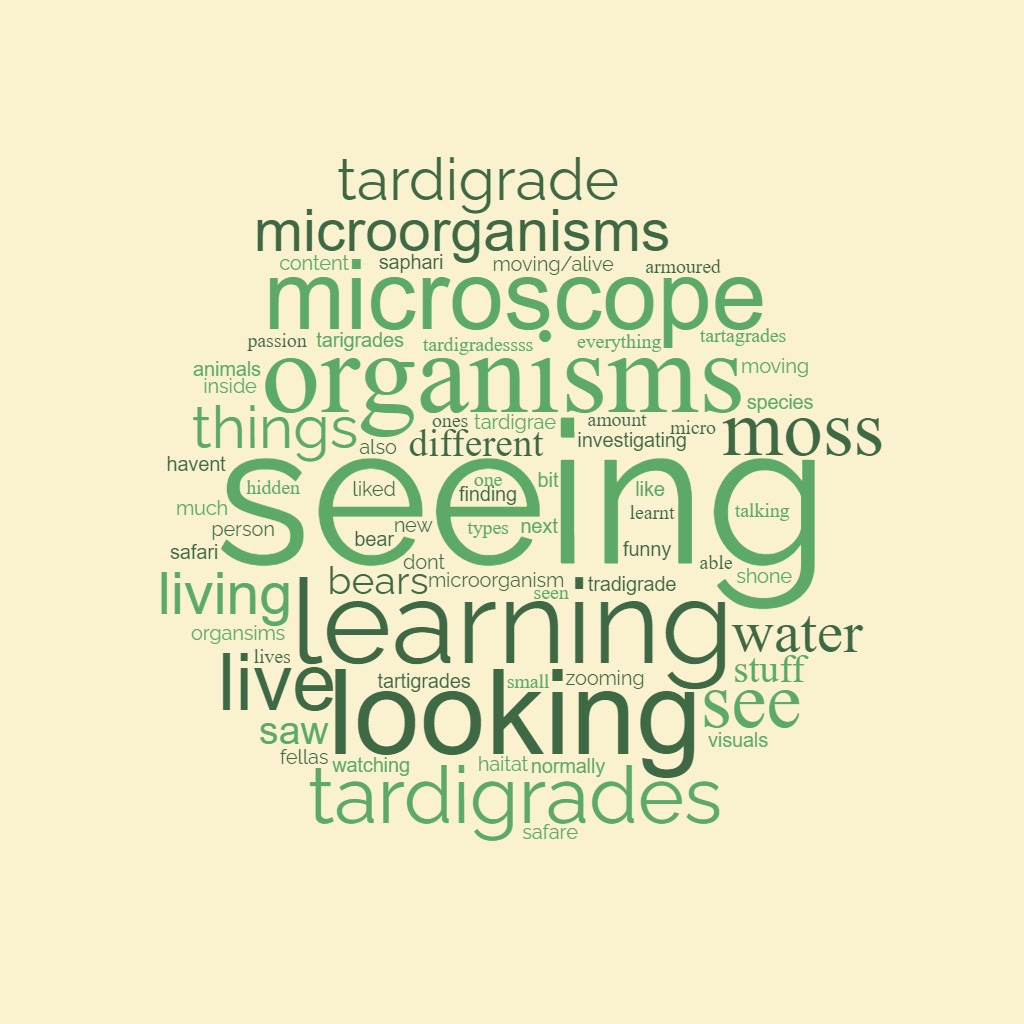
The experience was well received by most of the students and Wordcloud (Figure 3) shows the dominant words were ‘seeing/looking’ and ‘learning’ followed by ‘microscope, microorganisms, tardigrades/tardigrade.’
My favourite quotes are:
- I liked seeing the different animals and learning how they live.
- See stuff you don’t normally see
- Investigating living organisms that are hidden
- Seeing the funny small fellas like the tardigrades.
What could be improved?
I was conscious that this was a presentation, lecture style, which is something most GCSE students are not used to. I did ask some curriculum related questions during the introduction and the students did answer those. The main Moss Safari was me narrating what we saw and controlling the microscope, during that time, it is hard to engage with the audience directly.
Most students said they wanted more time.
Others mentioned the following:
- They wanted to use the microscopes / do it themselves.
- Wanted more detail about each organism.
- Wanted to see all the Big Five
- More student involvement
- Moving tardigrades
One said “Nothing it was perfect” – which I am happy to hear!
Conclusions
I enjoyed doing this Moss Safari and it seems a majority of the students involved did so as well. It was an interesting approach to a large audience and overall I think it worked well. Knowing that most of the audience was left wanting more is a good thing.
Inspiring students about moss, it’s inhabitants and to do some science for a hobby or a career is one of Moss Safari’s aims and the figures show that at least a few of the participants were encouraged to think about doing Alevel Biology, become a scientist or do Moss Safari in their own time.
Understanding what students learn from the session always fascinates and surprises me as well as what they like best. Tardigrades always steal the show.
In future sessions like these I might try to involve the audience more at the start. Maybe balance the narrative and the Moss Safari journey better – use more silence may be effective.
Thank you to George Scott-Smith for inviting me and the teachers and students at Uckfield who participated.
If you would like to do a Moss Safari at your school or event? – you can download resources here.
If you would like me to visit your school to do a Moss Safari?– you can contact me here.
Want to keep up to date with Moss Safari? Follow us on Social Media:
Twitter https://twitter.com/MossSafari
Facebook https://www.facebook.com/mosssafari
Instagram https://www.instagram.com/moss_safari/
 Moss Safari