I was invited to visit a local school, Holbrook Primary, for a morning during their Science week to do Moss Safari. What would these youngsters make of these microorganisms?
The school studio was where I was to meet and share the wonders of the life in moss with the classes. I set up my own microscope and camera at the front of the room, plugged into the projector and smart board (Figure 1). The teachers had set up the room with six tables. Three of the tables had microscopes set up which were on loan from the Royal Society of Microscopy (Figure 2). Three were set up where I put samples of dry and wet moss. The children were given booklets of activities to do based on the resources, including a tick list (Figure 4) I had made and sent ahead.

Four classes of about thirty children visited me with their class teacher: two Year 2 classes (aged 6-7 years) and two Year 4 classes (aged 8-9 years). Each session was 40 minutes long in which I did a 5 minute introduction to moss and the ‘Big Five’, a 10 minute live Moss Safari, where we saw lots of rotifers and nematodes and the odd tardigrade. The children then spent about 10 minutes examining the moss samples and completing their booklet and using the RMS microscopes to look at the moss squeeze themselves.
I focused my session on ‘adaptations’ covered at Key Stage 2 in the science national curriculum. This included the idea of habitats, microhabitats, adaptations for feeding, moving, and in this case surviving drying out.

Observations
From doing the Moss Safaris with the primary school I have reflected on what I thought went well and what I might do in the future.
The children were really interested and knowledgeable. Some knew that moss was present in the arctic and made links to the conditions that ‘moss creatures’ would need to survive. They also made connections between hibernation and the ‘stasis’ the moss organisms go into. We compared it to a long sleep, but where normal life processes were not needed (food and oxygen).
Children observe things really carefully. They were fascinated by the furriness of the dry moss and the smell of the wet moss. They knew all the different places they had seen moss at school and beyond.
I was worried about the length of the introduction with the PowerPoint, but the children sat quietly, listened, reacted and asked questions. I felt it was engaging enough for them and pitched appropriately.
The Moss Safari itself is dependent on what we have in the sample. That’s part of the excitement, but can also be dull if nothing is present. However, we did see a lot of active diatoms in these samples and I could talk about them. The children were absolutely aghast at the idea that some rotifers have survived 24,000 years in ice!
The RMS microscope loans for primary schools is a great initiative. They magnify to about x 20, so the nematodes could be seen as white wiggling hairs and the rotifers were translucent flat ‘worms’. Some children did have trouble using the microscope, seeing down the eye pieces and having the manual dexterity to focus. However, they only had ten minutes in this instance.
Engagement. My aim is to open a new world to young children, let them know that science is still being done (there are things we are still learning – new tardigrade species being found each year, how diatoms can be pollution indicators etc) and the microscopy is a great hobby or career. The students were very engaged (Figure 3), whether or not they will pursue careers in biology or STEM based on Moss Safari, I might never know.

Supporting Resources
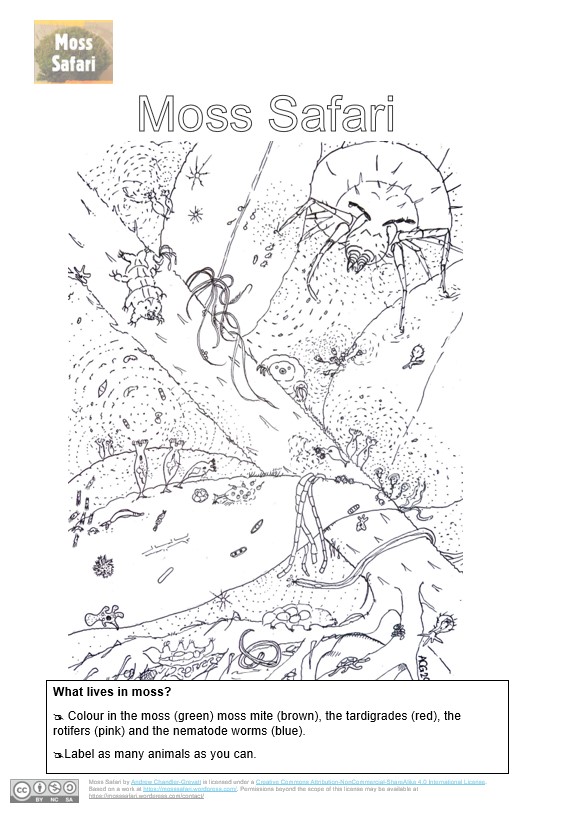
I spent some time drawing and designing the supporting resources to focus the children on adaptations of each of the Big Five. I made some colour-in sheets of the Big Five and some labeling activities focused on adaptations (see Gallery below and links section). The school made these into booklets for the children to complete.




Thanks to Paul and his colleagues at Holbrook Primary for making me so welcome and to the children who showed so much interest and enthusiasm, and taught me plenty too.
Links to additional Information
Royal Microscopical Society (RMS)
My PowerPoint and Worksheet resources are available here.
Do let me know if you use the resources or do a Moss Safari via Twitter @MossSafari or via the contact page. Let me know how you get on!
If you would like to book me for a Moss Safari online or in person, contact me for prices and further information via the contact page link above.
 Moss Safari