Rotifers – wheel animals
What to look out for
When they are actively feeding, rotifers cause strong swirling currents in the water. This is often a sign you might be approaching a rotifer when small bits of debris are swirling in these strong currents.
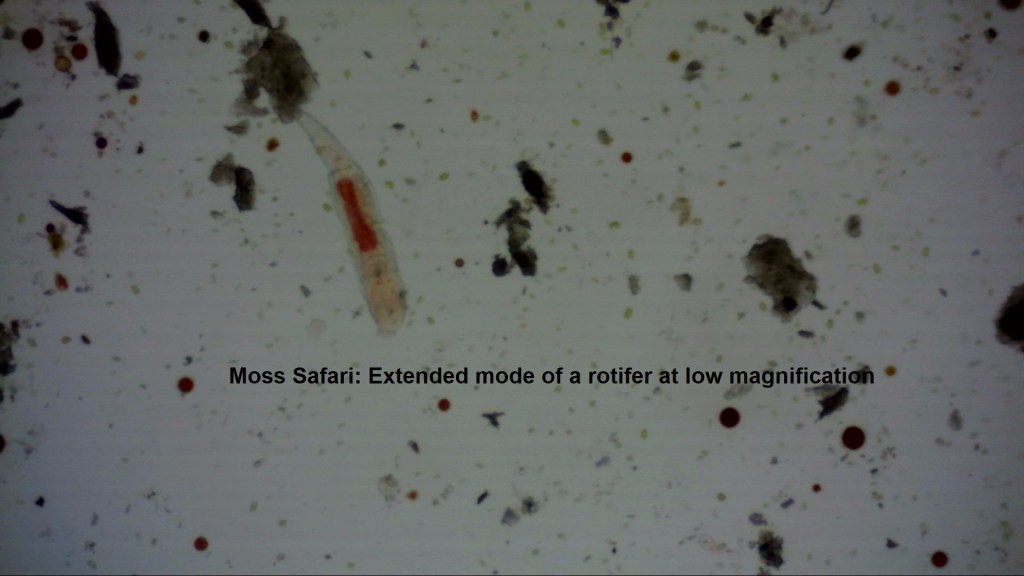
However, rotifers have more than one ‘mode.’ They can be in a contracted short and fat state, a resting mode. Sometimes, in moving mode, they anchor one end, stetch our long and thin, the bring their back end forward by contracting the body. A bit like an inch worm, or leech. The most spectacular mode, is feeding mode, where they are usually anchored, stretched out and at the head end they open what look like to large wheels. These are actually tiny hairs called cilia, moving in a fast synchronous movement to create a swirl of water that draws the water and any trapped food particles to the rotifers mouth. In this mode, the rotifer’s mouth can be observed opening and closing around half way down it’s body – I often think it looks like a blinking eye.
They will retract quickly from feeding or moving modes into ‘resting’ mode if disturbed, then usually will cautiously resume whatever they were doing.
Other things to look out for include: eggs inside their bodies, which are usually surprisingly large; empty skins of rotifers which they shed so look like a ‘ghost’ rotifer; and dead rotifers being eaten by protozoa (single celled organisms).
In my moss samples to date, I think I have only seen Bdelloid rotifers, which are the ones I have described above.


Some Rotifer facts
- Rotifer is Latin for ‘wheel bearer’, bdelloid is Greek for ‘leech-like’
- So far, only female bdelloid rotifers have been observed. Scientists are still debating how bdelloid rotifers have managed to survive so long by only reproduce asexually.
- Bdelloid rotifers, like several organisms that like in moss, can dehydrate quickly and go into a dormant state called anhydrobiosis. This means they can survive times of dehydration, lack or oxygen, and other extreme environmental conditions.
My learning
I have recently found out that the rotifer’s mouth actually grinds the food before ingesting it.
 Moss Safari