Wednesday 25th March 2026
Here in Woodingdean, Brighton it was a day of all weathers: we had rain, sleet, snow, hail and sunshine in just the afternoon. I collected the moss cushion that we are studying from my garden, where I had left it last month. It was surprisingly dry. Although it had been cold over the past month, there had not been a lot of rain. I was concerned that there may not be much activity in this cushion for Moss Safari Monthly March. However, I was proved wrong.
Focus
The focus of this session was ‘Watching What Happens.’ In the pervious session, we focussed on noticing. This session was to ask what was happening. We explored how these organisms move, feed and behave. We did this by following – staying with one organism and watching what it does.
We thought about what the organisms we see might be doing. I talked about the obvious signs of life – movement or feeding, but also the less obvious or unseeable like excretion, respiration, photosynthesis in plants.
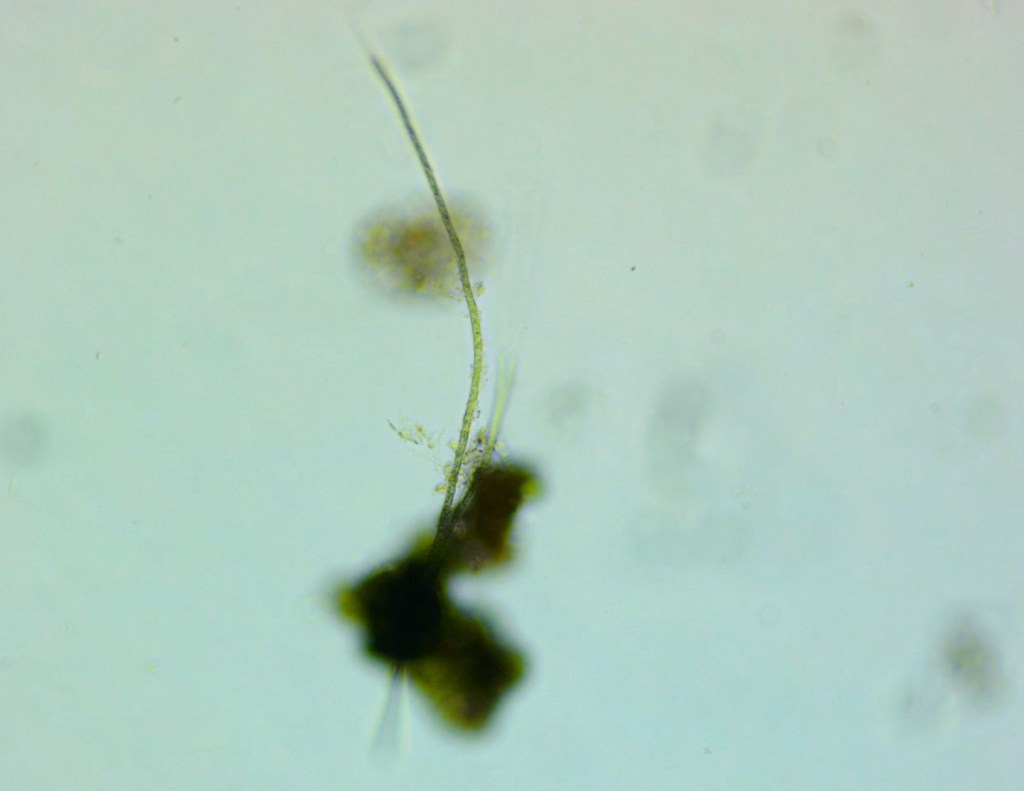
The cyanobacteria is moving before our eyes!
Among the tangle of moss and debris, we spotted fine chains of cyanobacteria (see image below), most likely Oscillatoria, gliding steadily. They moved with a quiet purpose, sometimes pausing, sometimes reversing, as if feeling their way through an invisible landscape. These filaments weren’t drifting, they were actively travelling, responding to their surroundings. Most likely, they were adjusting their position in relation to light, edging towards the conditions best suited for photosynthesis. But it may not just be about light. Subtle gradients in oxygen, moisture, or nutrients within that tiny droplet could also be guiding their movement. What we were witnessing was not just life, but behaviour: microscopic organisms making decisions.
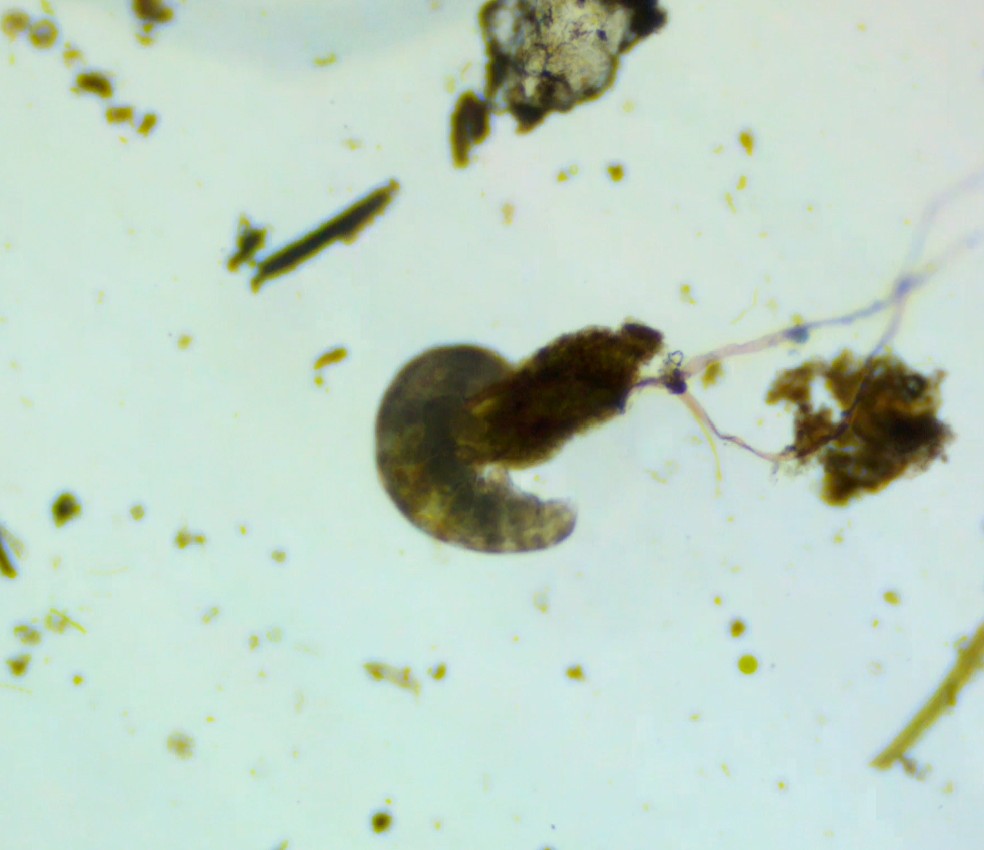
Tardigrade party
We were fortunate to find three active tardigrades. Under the microscope, these tiny animals don’t drift aimlessly, they walk with purpose, gripping onto fragments of moss and debris with their minute claws. Living in a thin film of water means everything is a bit unstable, so that firm grip helps them stay anchored as they move, feed, and explore. You might see one pause, cling tightly, and probe the surface beneath it, likely searching for food such as algae or plant cells. Then, with a slow, deliberate gait, it pulls itself forward again. It’s easy to forget at this scale, but what you’re watching is an animal navigating its environment, making its way through a miniature landscape one careful step at a time.
The first tardigrade was gripping onto apiece of debris, as they moved their legs, the debris moved round. We had some trouble focussing on their erratic movements, so we moved on.
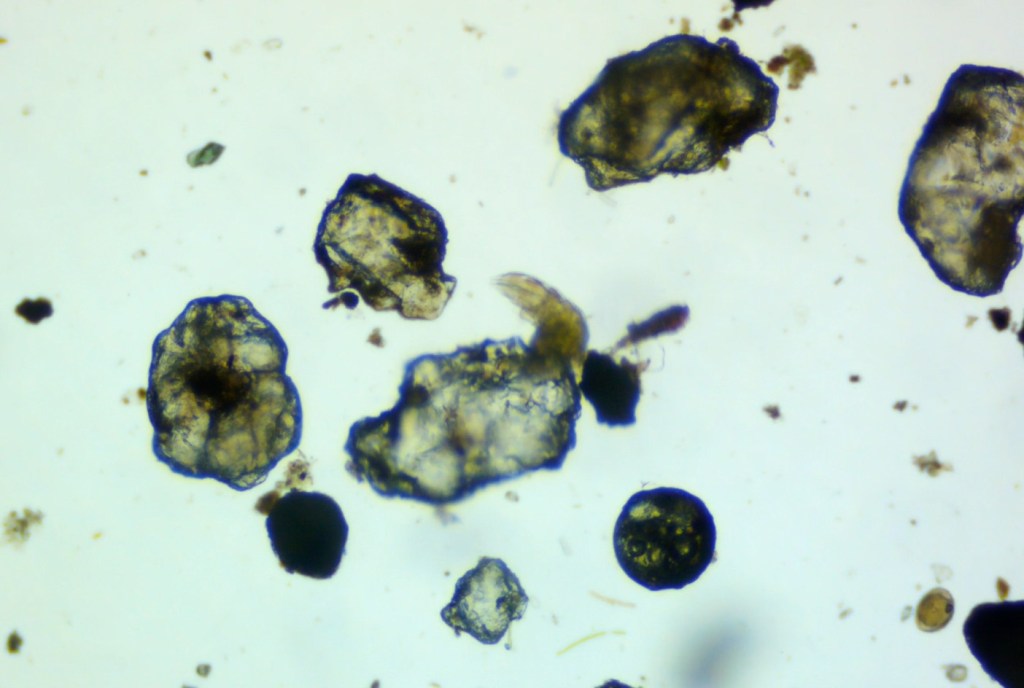
Amongst a collection of micro-stones, we saw another eutardigrade (soft bodied), this one clinging to one of the stones. Before we noticed the tardigrade, I was intrigued by one of the stones. It was darker and more spherical than the others and I wondered it it was a micrometeorite.
Micrometeorites are tiny visitors from space often appear as dark, perfectly rounded spheres or slightly irregular grains, sometimes with a subtly textured or pitted surface, quite distinct from the softer, more organic shapes around them. They arrive on Earth as cosmic dust, fragments shed from asteroids or comets that burn as they pass through the atmosphere, melting into droplets before cooling and settling gently onto the surface below. Moss, with its dense, sponge-like structure, is remarkably good at trapping and holding onto these particles. Over time, it acts like a natural net, collecting not just the products of life, but traces of the wider universe, quietly gathering stardust among its leaves. See Further reading below.
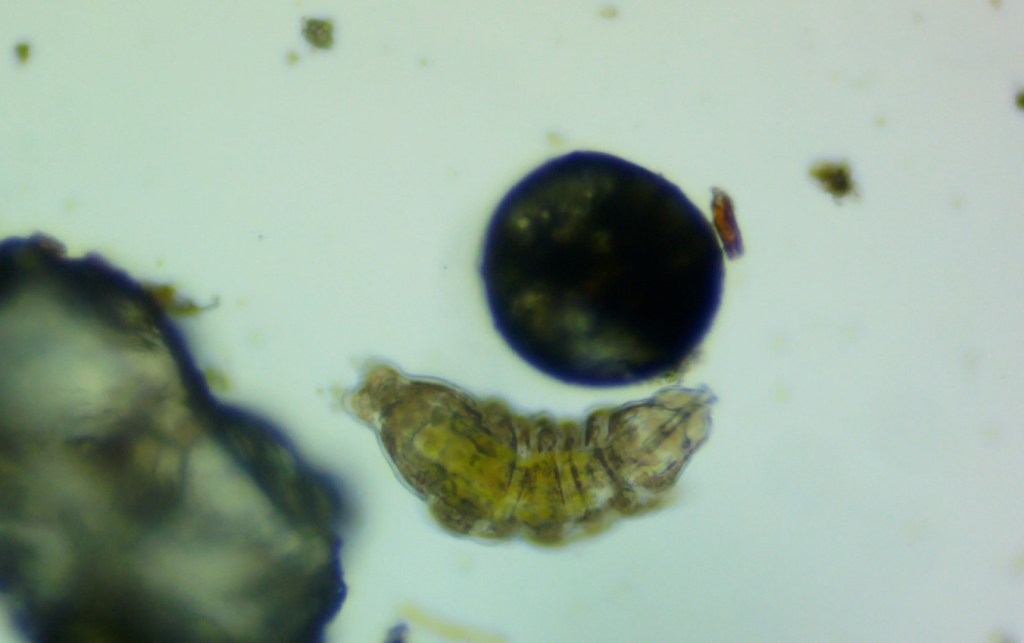
Our third tardigrade was apparently surfing a golden fragment of decaying moss leaf. When we increased the magnification, we could see some markings on their head.
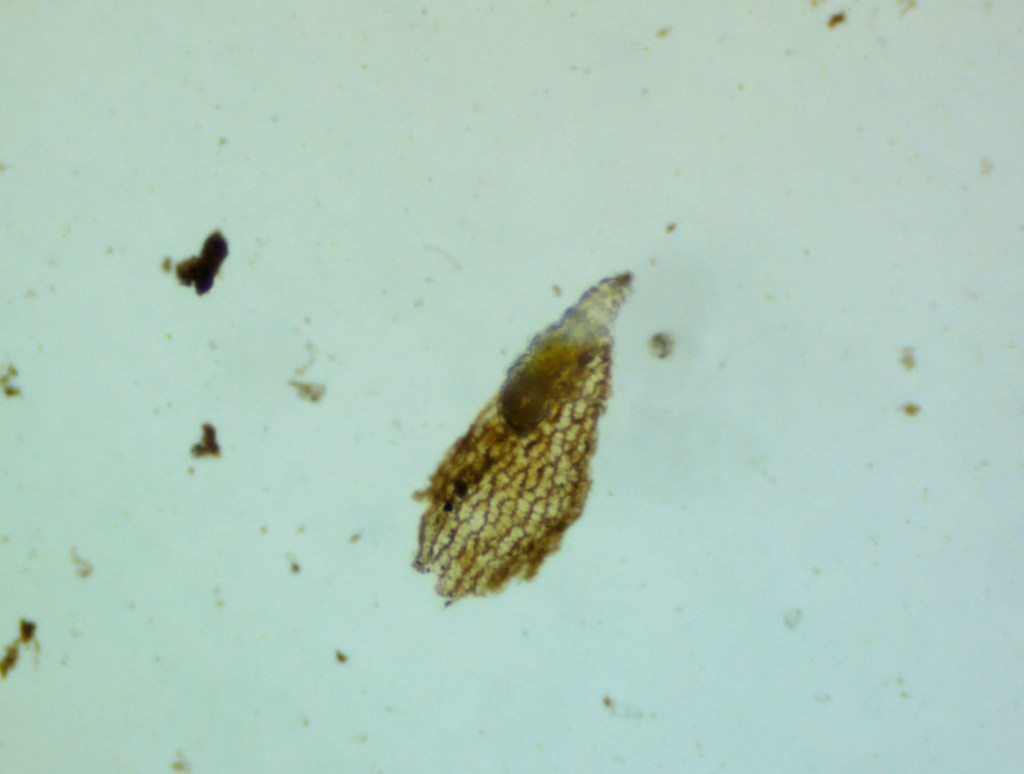
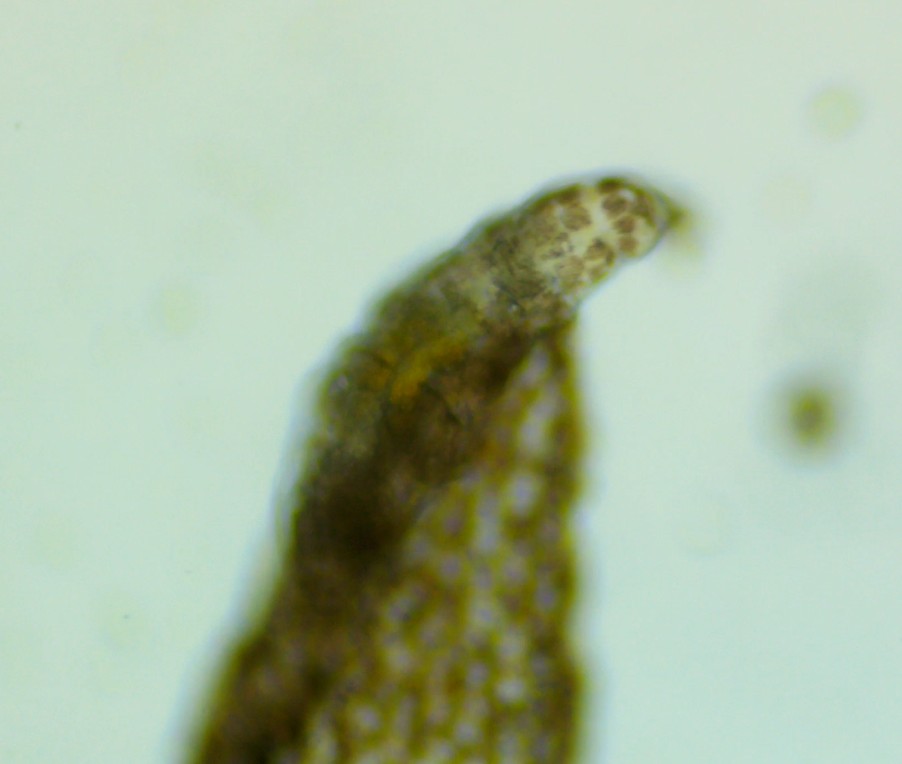
This striped individual was most likely a Ramazzottius, where the pigmentation shows up beautifully under the microscope as faint to distinct bands running along the body. Because the cuticle is transparent, these pigments can be seen either within the body wall itself or as underlying internal structures, giving a softly striped or banded appearance that becomes clearer as the animal stretches or contracts. These pigments are not just decorative. They may help protect the tardigrade from damage caused by light, particularly ultraviolet radiation when moss dries and becomes exposed. They could also play a role in stress tolerance, acting as antioxidants during desiccation, or even provide a degree of camouflage against the complex textures of the moss. What we see as simple stripes may therefore reflect a suite of adaptations that help this tiny animal survive in a highly changeable environment.
We had an eventful, life filled, question triggering Moss Safari Monthly in March. The amount of activity was surprising. It reminded us that those apparently dry moss cushions can have a host of organisms activity living their lives, not just being dormant.
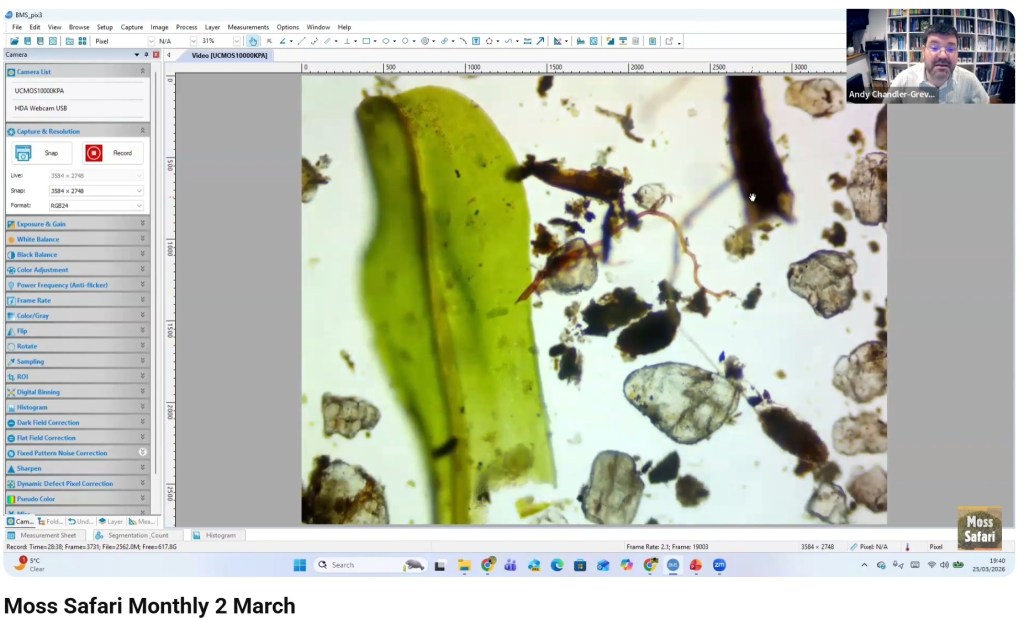
Thank you to all the viewers and those who signed up, but caught up on the video afterwards.
Feedback so far
The reactions and questions during a Moss Safari allow me to gauge how we people are engaging with the event. In addition, I ask viewers to complete a short survey to understand their views.
There’s something quietly magical happening in our Moss Safari Monthly sessions. Time and again, participants have described the experience as eye-opening, engaging, and surprisingly calming, with many encountering living microscopic creatures for the very first time. What stands out most is that sense of discovery: the realisation that an entire, bustling world exists right under our feet, hidden in something as ordinary as a patch of moss.
The sessions have developed a relaxed, friendly feel, more like a shared exploration than a formal lesson, which seems to work beautifully for all ages. Families in particular have noted how absorbed children become, often staying curious and engaged throughout. Themed sessions, such as those focused on “noticing”, help give a gentle sense of direction, while still leaving plenty of space for wonder, questions, and unexpected finds under the microscope.
Perhaps most rewarding is the shift in perspective people describe afterwards. Participants leave not just having seen something new, but looking at the world differently, more attentive to the small, overlooked details of everyday life. A few practical suggestions have come through, such as making slides easier to follow and labelling specimens more clearly during demonstrations, but overall the message is clear: people are fascinated, inspired, and keen to keep exploring.
Take-home thought
Seeing movement reminds us that this world is not still. It is ongoing.
Follow up activity
Watch one small organism outdoors (an ant, spider, fly, bird) for two full minutes and notice how its movement changes over time.
Join us next month: Wed 22 April 2026 7-8 GMT, Everything Is Connected
Sign up here.
Further Reading on micrometeorites
BBC News (2026) Call for citizen scientists to collect space dust. Available at: https://www.bbc.co.uk/news/articles/cn89zymv2zdo (Accessed: 6 April 2026).
Van Ginneken, M., Wozniakiewicz, P.J., Brownlee, D.E., Debaille, V., Della Corte, V., Delauche, L., Duprat, J., Engrand, C., Folco, L., Fries, M. and Gattacceca, J., 2024. Micrometeorite collections: a review and their current status. Philosophical Transactions of the Royal Society A: Mathematical, Physical and Engineering Sciences, 382(2273). https://doi.org/10.1098/rsta.2023.0195
 Moss Safari