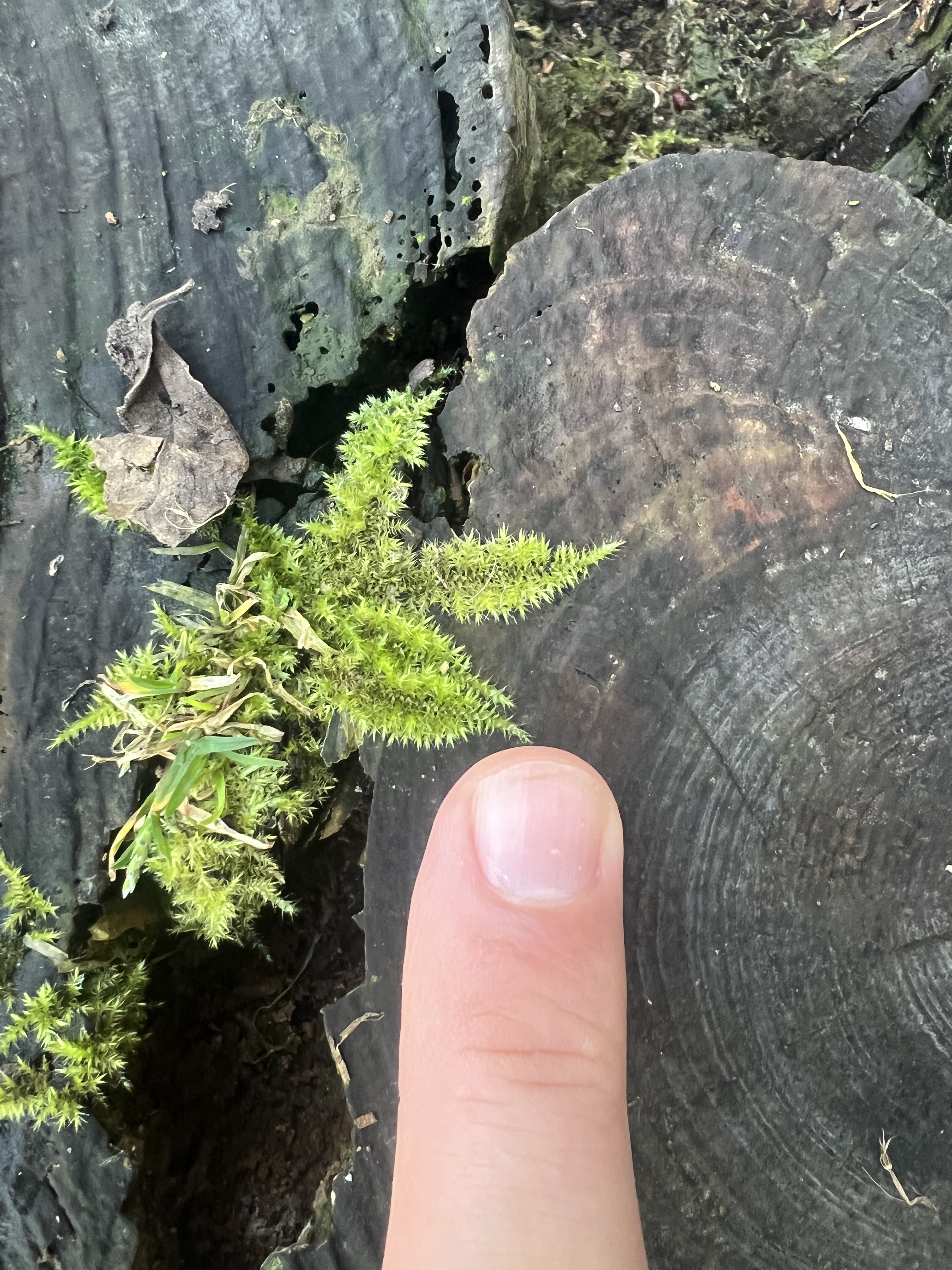
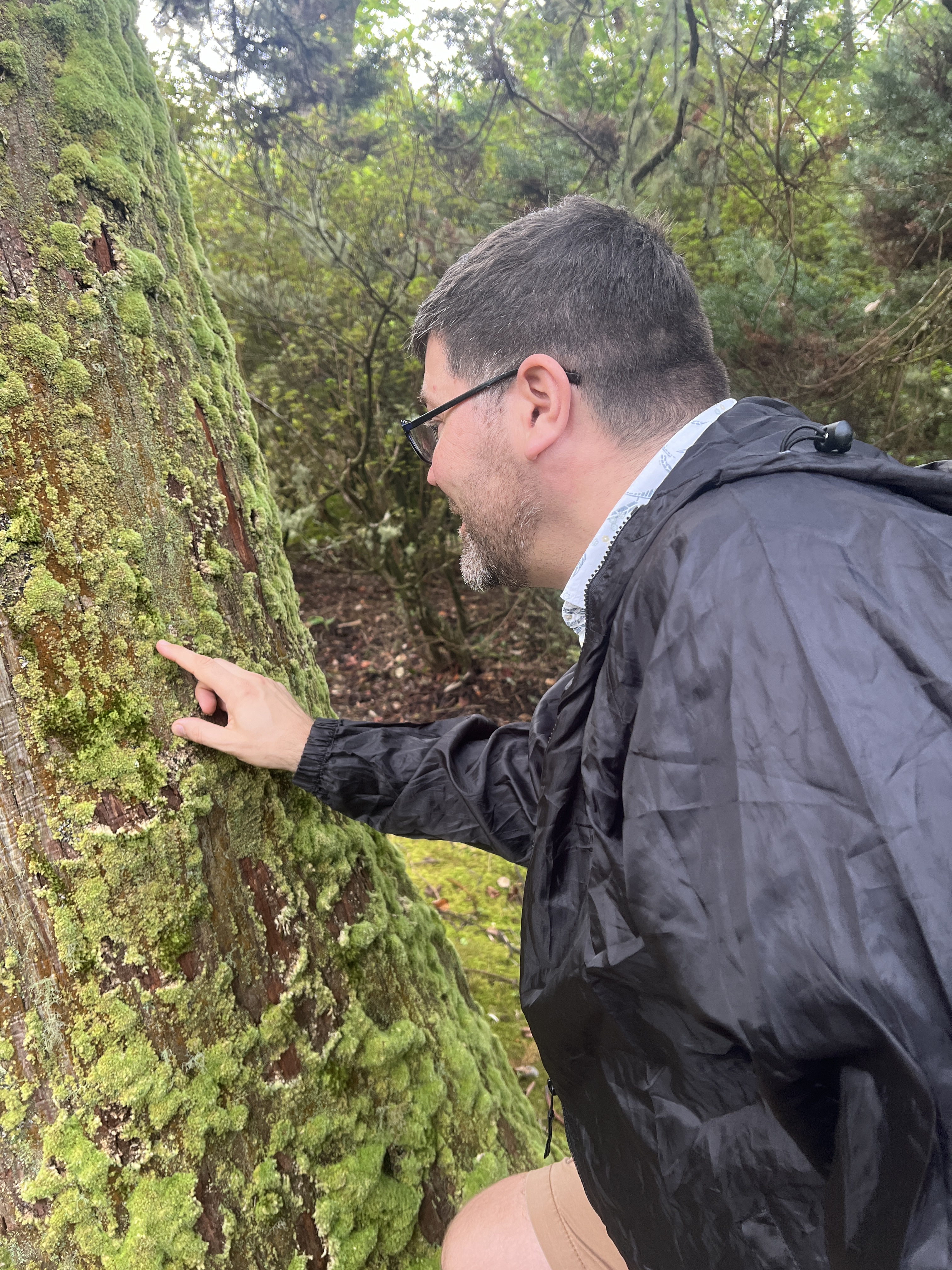
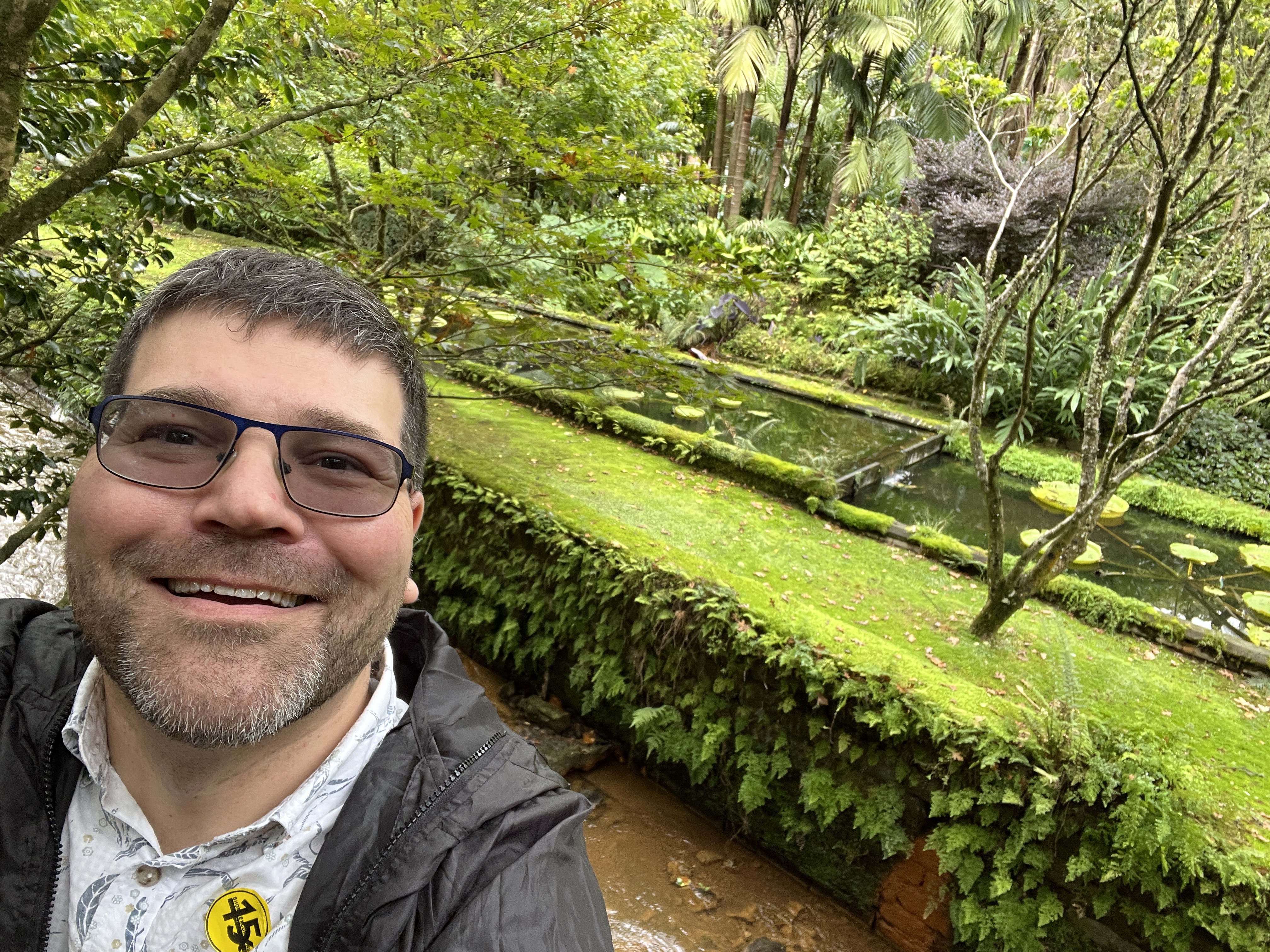
As you can see below, I am very happy in mossy places. I love looking at moss. I used to feel intimidated by learning the names of mosses and being able to identify them. It is tricky because the mosses are small and identification requires a lot of new vocabulary. However, I have broken it down into manageable tasks. I am starting with urban mosses around me. Using this next resource is helping me distinguish between each type of moss.



Discovering Mosses Series: Steps to Identify a Moss
You already know what mosses are, how they grow, and what a moss plant is like. Now it is time to put that knowledge to work. This step by step approach helps you decide what you have found using simple observations first, then a closer look, and finally a microscope only if you need it for a final decision.

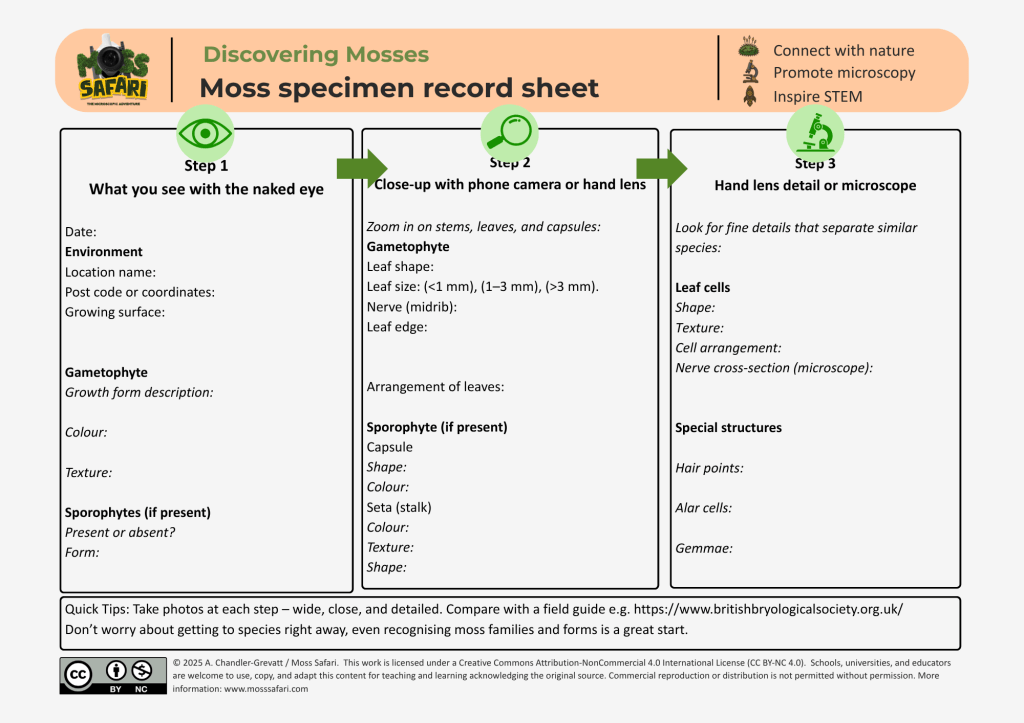
Step 1: What you can see with your eye
Begin with the moss in its place. Note the environment and the surface where it grows. Is it on soil, rock, bark, a wall, a roof, a tree base, or a damp patch by a drain. Stand back and describe the overall growth form. Is it an acrocarpous cushion or a pleurocarpous mat. Record colour in plain terms such as bright green, yellow green, dark green, brownish, or reddish tints. Feel and look for texture such as shiny or dull, crisp or floppy. If sporophytes are present, simply note that they are there and whether capsules seem upright, nodding, or curved. These big picture clues often narrow your options quickly.
Step 2: Look closer with a phone or hand lens
Now zoom in on stems, leaves, and any capsules with a macro setting or a hand lens. Describe leaf shape in everyday language such as narrow, broad, rounded, pointed, or notched. Estimate leaf size using three bins, tiny less than one millimetre, small one to three millimetres, larger more than three millimetres. Check the nerve. Does it reach the leaf tip, stop short, or seem absent. Look at the leaf edge for clues such as smooth, toothed, rolled under, or a translucent border. Notice how leaves are arranged. Are they spiralled around the stem, flattened in two rows, or clustered near the tips. If sporophytes are present, note capsule shape such as cylindrical, globular, or pear shaped, and whether the capsule is upright or drooping. Look at the seta colour and texture, for example green, yellow, red, or brown, smooth or rough, straight or twisted.
Step 3: If needed, confirm with a microscope
Only use this step when Step 1 and Step 2 leave you uncertain between lookalikes. Examine leaf cells. Are they long and narrow or short and boxy. Are they smooth or covered with papillae bumps. Compare cell arrangement across the leaf. Do the cells change from base to tip. If you can make a thin section through the nerve, check whether it has thickened central cells or is absent. Look for special structures that separate similar species such as clear hair points at leaf tips, distinctive alar cells at the leaf corners, or gemmae, the tiny reproductive buds on leaves or stems. Take a quick series of photos at this stage so you can compare later.
How to use this infographic
- Start with Step 1 and answer the simple questions about environment, surface, growth form, colour, and texture. Write short phrases rather than long sentences.
- Move to Step 2 and add the close up details from your phone or hand lens. Tick the size bin for leaves, record the nerve, the leaf edge, and the arrangement. Add any notes on sporophyte capsule shape and the seta.
- Only go to Step 3 if two or more species still match. Check cells, hair points, alar cells, and gemmae. Take one wide photo, one close photo, and one detailed photo so you can review later alongside a field guide.
- Compare your notes with an introductory key or a beginner’s field guide and make a best fit identification. It is fine to stop at genus or family when species is uncertain. See references and resources section below.
Download the Moss Specimen Record Sheet
The printable record sheet follows the same questions as the Steps to Identify a Moss guide, which keeps your notes consistent from first look to final decision. Download the sheet, take it outdoors, and fill it in as you go. It includes spaces for environment, growth form, colour, texture, leaf details, capsule notes, and any microscope observations.
Quick tip: Photograph each step, wide then close then detailed, and compare with a trusted guide when you get home. Even a confident family or genus match is real progress on your moss safari.
Find the complete set of resources on the Discovering Mosses Tab and sign up for my free newsletters so you know when the next batch of mossy infographics arrive!
Join in and support
I post regular finds and updates on Bluesky, Facebook and Instagram. Come and say hello, and share your photos. I am learning as I go, and I will certainly make the odd mistake. Polite corrections are very welcome.
All of the resources in this project are free to use. If you would like to support my educational work, you can leave a tip or pick up Moss Safari merchandise. Your support helps me keep creating and sharing more moss magic.

References and Resources
These are the sources that I used to research this infographic and blog.
Neil Bell (2025) The Hidden world of mosses. Royal Botanic Garden Edinburgh.*
Ian Atherton, Sam Bosanquet, Mark Lawley (Editors) (2010) Mosses and Liverworts of Britain and Ireland a field guide. British Bryological Society. Available from here.
Dominic Price and Clive Bealey (2022) A field guide to bryophytes. The Species Recovery Trust. Available from here.
Elizabeth Lawson (2024) Moss and Lichen. Reakton Books.*
*I use Amazon Associates to help fund Moss Safari Education Activities. Clicking and purchasing on these links may generate some small income at no cost to you.

Generative AI use Statement
As part of the Discovering Moss series, I use generative AI to review my clarity of communication both in design and in writing. Every post is reviewed and fact-checked by me, combining human curiosity with responsible AI assistance to share the wonder of mosses.
 Moss Safari