Now that we know what a moss is (and is not) and can tell the difference between the two main growth forms, it’s time to look more closely at what makes up a moss plant. Mosses are small and simple, yet when viewed under a hand lens or microscope, they reveal fascinating details that show how perfectly adapted they are to their miniature world. Understanding these parts helps us see mosses as living plants rather than just green fuzz on walls or trees.


Mosses share some similarities with the plants we already know, such as sunflowers, roses, or trees. They grow, photosynthesise (make food from the sun), and reproduce (make new moss plants). But unlike flowering plants, mosses have no true roots, stems, or leaves. Instead, they have structures that look and behave like these parts but are much simpler. This simplicity is what makes mosses unique, ancient, and resilient. They have survived for millions of years in some of the harshest conditions on Earth, from icy tundra to dry stone walls.
In this infographic, you’ll see how mosses are compared with more familiar plants to help make sense of their structure. Notice how the main green part of the moss is called the gametophyte, the stage that makes the male and female cells needed for reproduction. The tall stalk with the capsule on top is the sporophyte, which grows out of the gametophyte and releases spores to start new moss plants. The rhizoids act a bit like roots, anchoring the moss to its surface, while the leaf-like structures are often only one cell thick, allowing them to absorb water directly from rain and dew.
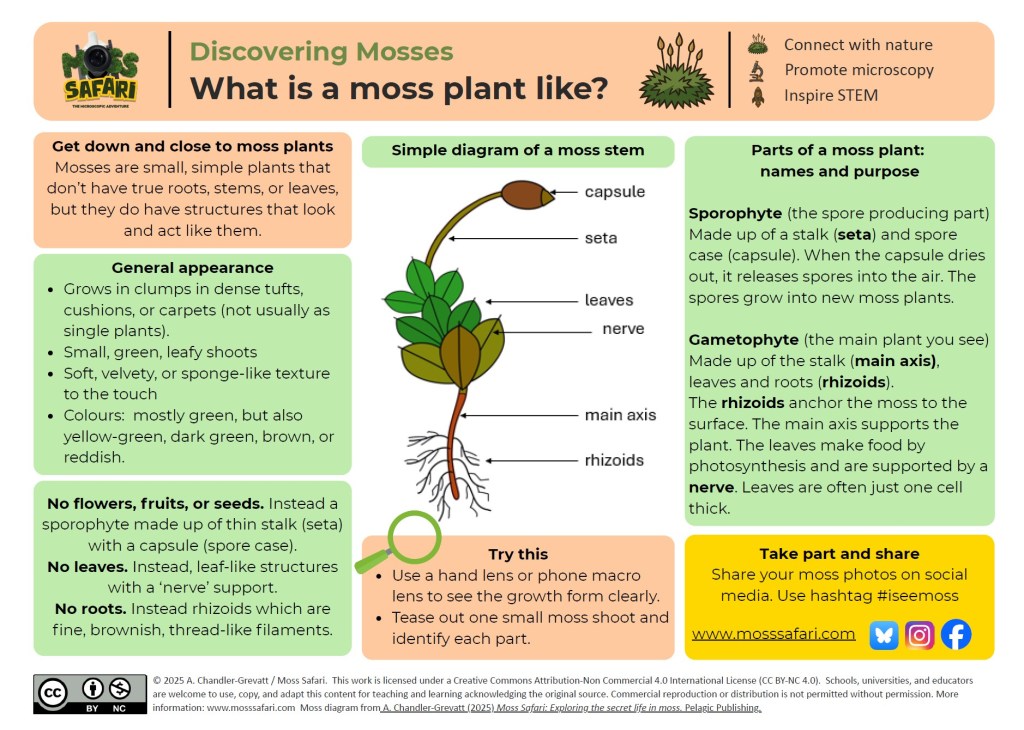
How to Use the Infographic
- Look closely at each labelled part of the moss diagram and read what it does. Notice the similarities and differences compared to the plants you know.
- If you have a hand lens or a macro lens on your phone, find a patch of moss outside and take a closer look. See if you can spot the leafy shoots, the sporophyte stalks, and the tiny capsules. Note that not not all mosses produce sporophytes all the time.
- Gently tease out a small piece of moss (no bigger than your thumbnail) and place it on a piece of paper. Identify the rhizoids, the stem-like axis, and the leaves.
- Compare what you see to the infographic and note which parts you can identify with your lens and which you might only see under a microscope.
- Share your discoveries on social media using #ISeeMoss and tag @moss_safari to join the community of moss explorers.
Each moss you observe reveals just how complex and beautiful these tiny plants can be. The more you look, the more you’ll notice the intricate details that make mosses so remarkable and so easy to become fascinated with.
In the next part of the Discovering Mosses series, we’ll explore Where Does Moss Grow? to discover the surprising places mosses make their homes, from shady garden corners to city rooftops and tree trunks.
Join in and support
I post regular finds and updates on Bluesky, Facebook and Instagram. Come and say hello, and share your photos. I am learning as I go, and I will certainly make the odd mistake. Polite corrections are very welcome.
All of the resources in this project are free to use. If you would like to support my educational work, you can leave a tip or pick up Moss Safari merchandise. Your support helps me keep creating and sharing more moss magic.
References and Resources
These are the sources that I used to research this infographic and blog.
Neil Bell (2025) The Hidden world of mosses. Royal Botanic Garden Edinburgh.*
Ian Atherton, Sam Bosanquet, Mark Lawley (Editors) (2010) Mosses and Liverworts of Britain and Ireland a field guide. British Bryological Society. Available from here.
Dominic Price and Clive Bealey (2022) A field guide to bryophytes. The Species Recovery Trust. Available from here.
Elizabeth Lawson (2024) Moss and Lichen. Reakton Books.*
*I use Amazon Associates to help fund Moss Safari Education Activities. Clicking and purchasing on these links may generate some small income at no cost to you.
Generative AI use Statement
As part of the Discovering Moss series, I use generative AI to review my clarity of communication both in design and in writing. Every post is reviewed and fact-checked by me, combining human curiosity with responsible AI assistance to share the wonder of mosses.
 Moss Safari