New Scientist Live seems to get bigger every year. Last year I was here with VITTA Education; this year I was with the Quekett Microscopical Club (QMC) to bring Moss Safari to their stand.
I didn’t do it alone. I had the support of Jude Dean, a Chemistry undergraduate, who has been helping me with Moss Safari this year. We arrived early on Saturday with our trays of rehydrated moss and set up our little patch of damp, green world.

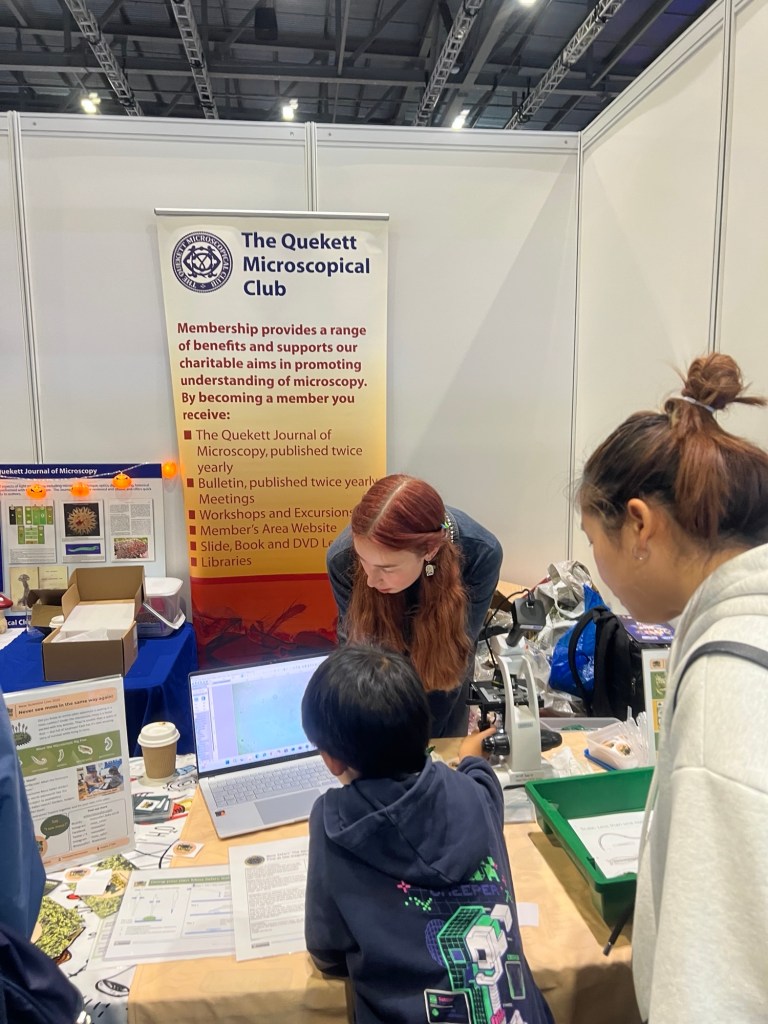
What our corner of the stand looked like
The Moss Safari set-up was deliberately simple and tactile:
- A tray containing three Petri dishes with soaked moss
- Plastic pipettes to extract the “moss organisms”
- A microscope with a camera connected to my laptop, projecting live to the screen
- Moss Safari identification sheets, info sheets, bookmarks and free stickers
- Copies of the Moss Safari book and the four enamel tardigrade pins for sale
It was the perfect mix of “come and look” and “take something away”.
The flow of people (and the four opening questions)
Once the doors opened on Saturday, the flow of people never really stopped. Our standard openers became a rhythm:
“Welcome to Moss Safari!”
“Have you heard of Moss Safari before?”
“Do you know what lives in moss?”
and sometimes “Have you heard of a tardigrade?”
Saturday and Sunday were dominated by families: parents with small children, teenagers, grandparents pulling excited grandchildren forward by the sleeve. Monday brought more school groups, STEM clubs and sixth formers.
We spoke to maybe hundreds. Some stopped for five seconds. Others stayed for ten minutes. A handful came back twice.
Who we met
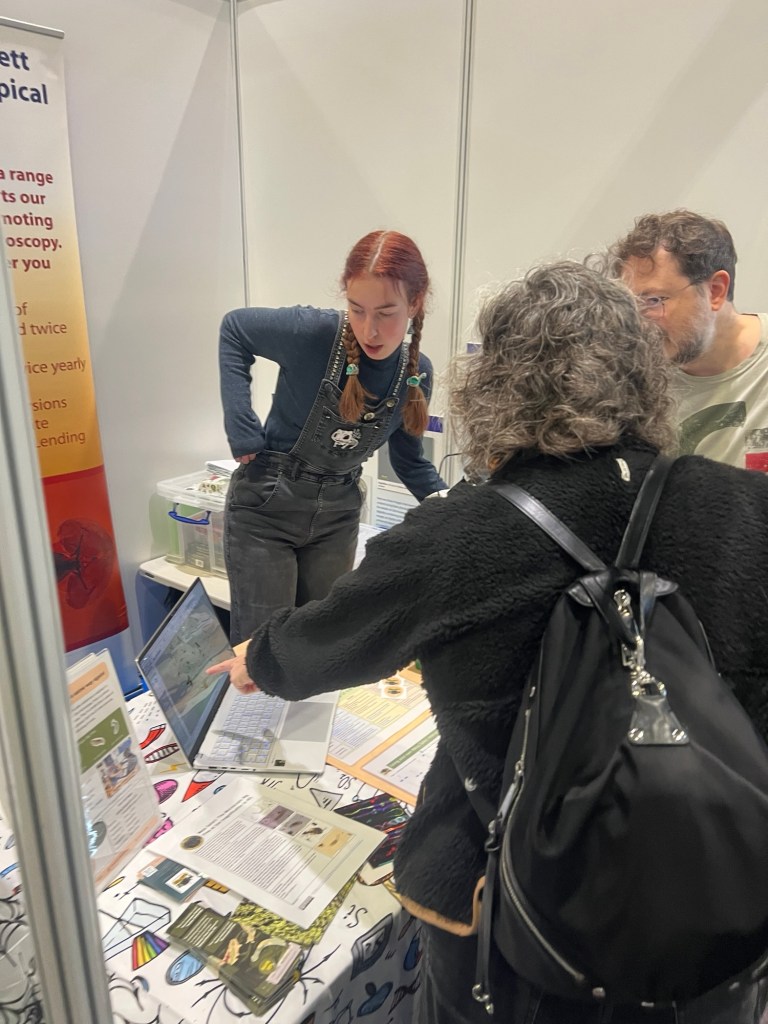
This was one of the most unexpectedly rich parts of the weekend. We met:
- School teachers who came to the stand specifically to say they already use Moss Safari resources in their classrooms. How they use it in Year 7, for open evenings and science clubs. Another told me her Year 8s “won’t shut up about tardigrades now”.
- People from other organisations with the same mission: science communicators from the Royal Entomological Society and the Royal Botanic Gardens, equally thrilled to see someone championing tiny life.
- A boy obsessed with woodlice, already collecting them at home; I introduced him to the rosy woodlouse and to tardigrades. His face when he saw a living water bear on-screen was a total highlight.
- Teachers I used to train, who are now teaching their own students, it’s always great to see old faces in new contexts (and get hugs!).
- A retired gentleman who bought my book on Saturday and came back Sunday to tell me (warmly but insistently) that I “really ought to advertise it more boldly”. Solid advice.
- And in the middle of all that, I somehow ended up giving earnest career advice to a Year 11 student who is now reconsidering her A-level choices.
The tardigrade in-crowd
The social dynamics of tardigrade knowledge is a phenomenon in itself. When I ask if people have heard of tardigrades/water bears, the responses fall into three distinct camps:
- The majority — blank stare, polite curiosity
- The recognisers — “Yes! They’re the almost-indestructible ones!”
- The ultras — eyes widen, breath quickens, encyclopaedic download begins
There is nothing more satisfying than moving someone from category 1 to category 3 in the space of 60 seconds by showing them a living tardigrade wriggling across the screen.
What this weekend showed me
It is tiring work — speaking almost continuously, riding a river of questions, explaining the same concepts a hundred times with the same energy, watching for that “click” moment on people’s faces. But it is absolutely worth it.
The surprise of the weekend was how many people — especially teachers and technicians — already knew Moss Safari and are using it in schools. That is not something you see from a desk. You only discover the impact when you stand at a table and watch people’s faces as they recognise you.
The most encouraging part is always the shift — that moment when someone looks at moss differently. When a parent or a teenager or a retired engineer leans in and says:
“I had no idea there was anything living in there.”
That single sentence is the whole mission in one breath.
And what happens next…
Moss Safari doesn’t end at New Scientist Live. This autumn we have more public engagement planned, with new outreach sessions, resources being re-designed for schools, and new content coming to the website and social channels,including a Moss Safari video series and fresh educational materials.
Half term 25 Oct -2 Nov: Look out for the brand new Discovering Mosses Infographics for people and families who want to learn about moss in their local environment.
January 2026: Band new, fresh look Moss Safari Resources will be downloadable – pitched to primary, secondary and post 16 audiences.
The microscope stage lights may be off for now, but the work continues behind the scenes — and the moss is still full of life.
The Moss Safari NSL Merch for two weeks
At the stand we did a special deals:
- Moss Safari signed book (£24.99) now £19.99
- The complete collection of Moss Safari Tardigrade Pins (£5 each) all four four £16. I’ll send one of each colour unless you message me and ask for your own colour combination
- The Moss Safari Merch pack: 2 x vinyl stickers and 1 x button badge (RRP £5) now £4
If you use the code NSL2025 we can honour these deals until Monday 3rd November.
Take a look and buy these items to support the educational work of Moss Safari.

Acknowledgments
I want to acknowledge with huge thanks to the Quekett Microscopical Club for allowing me to exhibit Moss Safari. Particular thanks to Robert Ratford for championing Moss Safari. Also the wonderful Quekett volunteers. Also huge thanks to Jude Dean for supporting the Moss Safari exhibit so knowlegabley and enthusiastically.
 Moss Safari