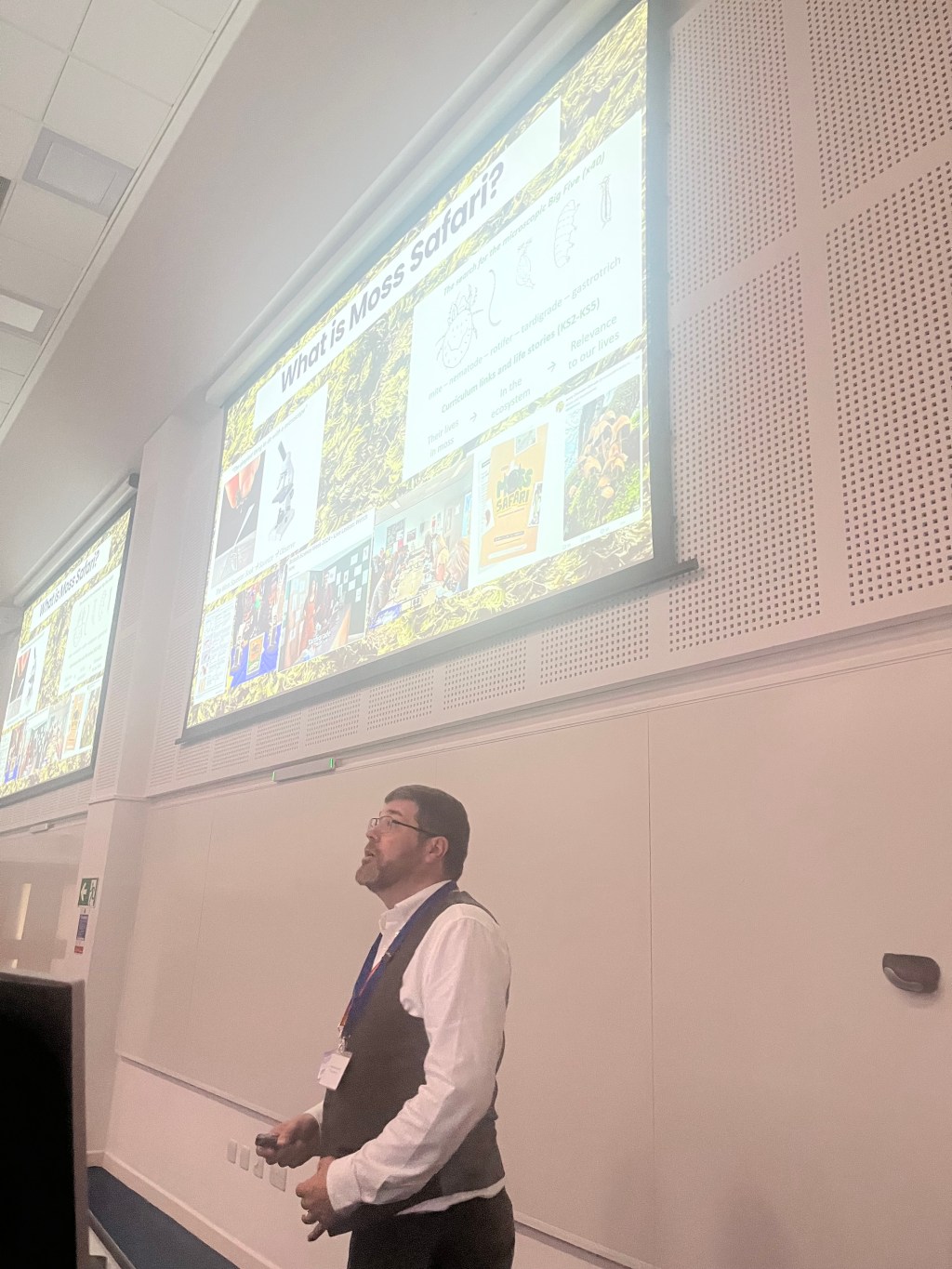
Friday 27 June, 2005. Huxley Building, University of Brighton
I am fortunate enough to work at a university where interdisciplinary research in encouraged. So, I was excited to learn about a brand new Centre of Research and Knowledge Exchange Excellence – the Centre for Environment and Society, headed by co-directors Dr Corina Ciocan and Professor James Ebdon from the School of Applied Sciences. Having been accepted as a member of the group, I took the opportunity to present the work of Moss Safari and the research opportunities it offers.
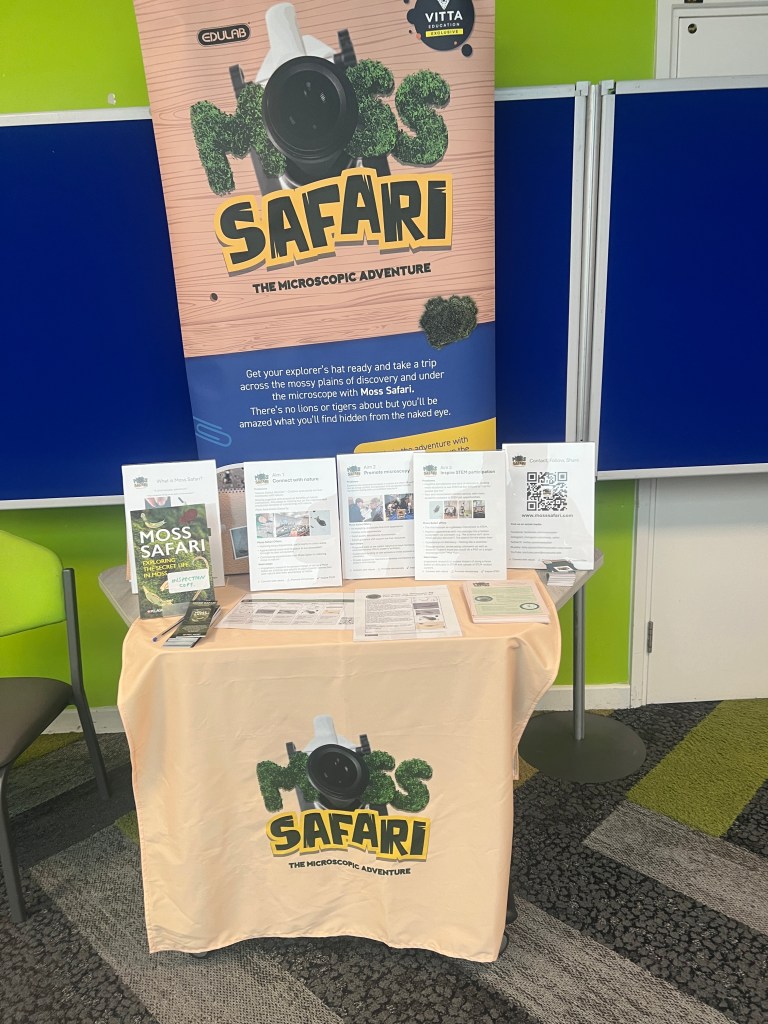
I’ve been in my education bubble for a long time and it was a great opportunity for me to visit another campus and be in the company of biologists, geologists and ecologists. The launch was well attended, I estimated about 70 people from a variety of organisations including Southern Water and PhD researchers looking at things as diverse as the predator populations of Africa to exploring the experiences of the visually impaired in blue spaces (water environments).
I had a stand and a ten minute slot to explain Moss Safari. I did this from the perspective of the three aims of Moss Safari:
🌿 Connect with nature
🔬 Promote microscopy
🚀 Inspire STEM
and explored the issues related to each aim, how Moss Safari attempts to challenge these and research opportunities. Namely, I want to do a State of the Nation research project on the quality of microscopes in school and the experiences of using microscopes in secondary education – my hypothesis is that on average microscopes are of poor quality, first experiences of microscopy are often lacking and that a young person is likely to get between 0-5 hours max using a microscope over their five years of secondary education.
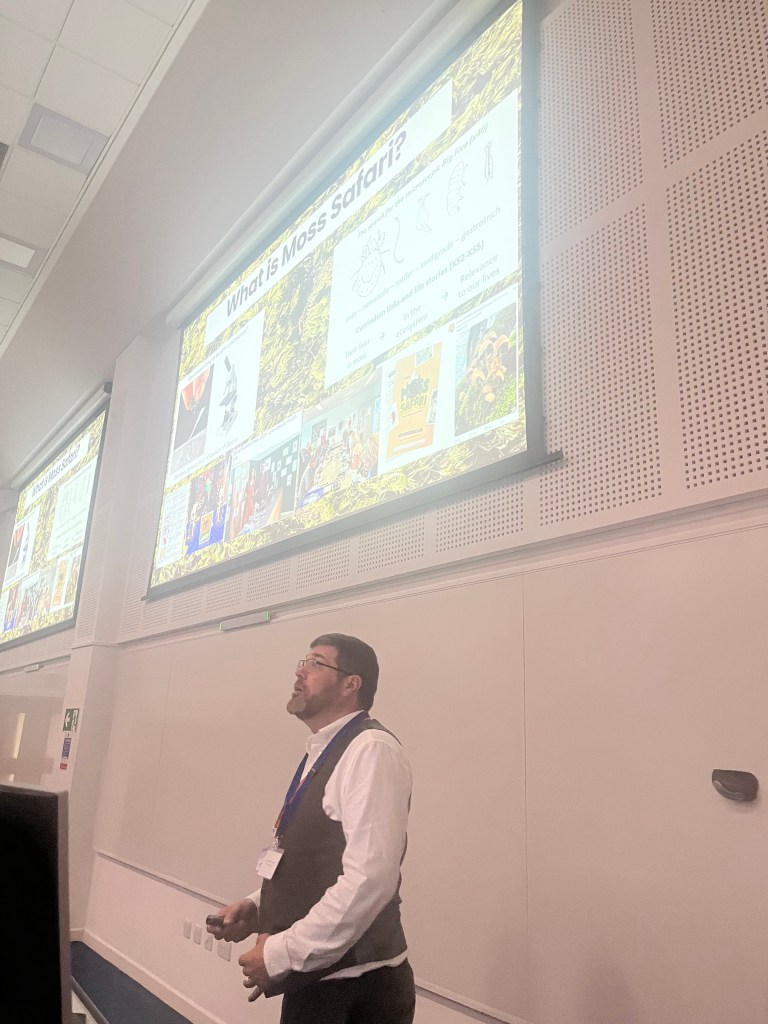
I was impressed by the far reaching interest. That moss itself is overlooked, the value of good quality outreach, the poor experiences of microscopy in school. I also got to talk about shared experiences of tardigrades and Queer Theory in (micro)ecology. I had kind of found my people! I am looking forward to seeing what develops. This was a great networking opportunity and I learnt a lot about other research projects. Let’s see where this take us!
The slide deck that I used is below. The pdf is downloadable.
If you would like to contact me, please use this form.


 Moss Safari