Over the past few years I have tried to do some events for British Science Week. This year came an opportunity that I was not expecting – to showcase Moss Safari on cBBC’s Live Lesson, that goes out to hundreds of thousands of children. In this blog I reflect on the experience, the impact, and what next.
The call
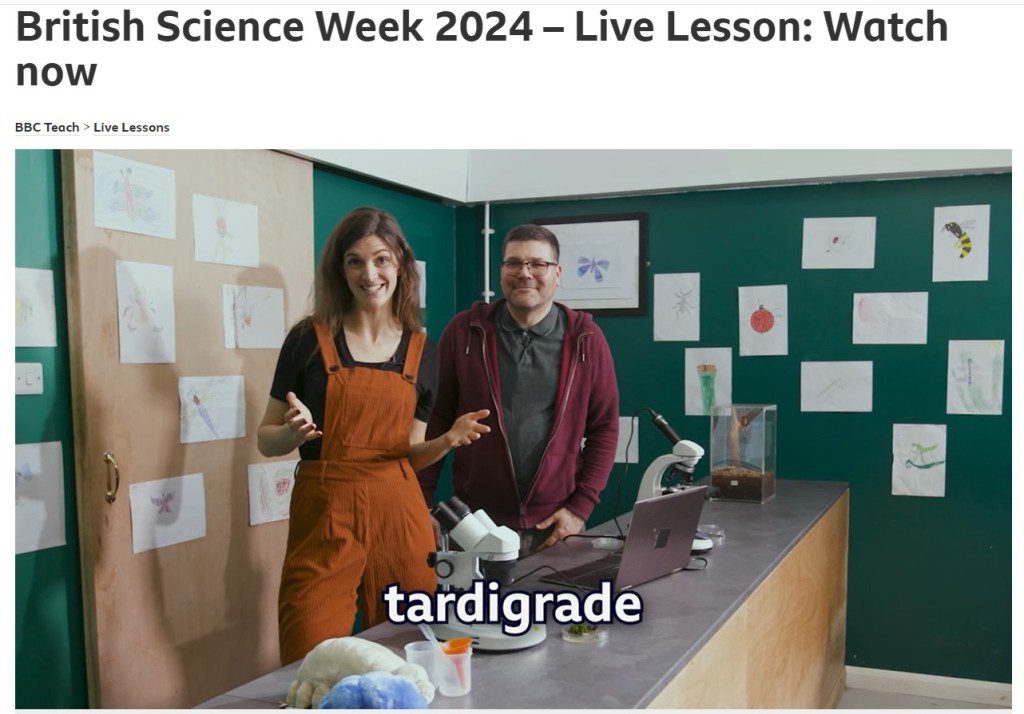
Last November I received an email asking if I would be willing to feature tardigrades on the BBC’s Live Lesson. Of course I said yes and before I knew it, in early January I was on a train to the Bug Parc in Norwich with a pocket full of tardigrades and my microscope.
Leading up to this, I had a short script to learn , sourced some pictures of tardigrades for the task associated with the live lesson.
My photos of tardigrades and my more random techniques mean that I cannot easily get more than one tardigrade in a photo nor can I guarantee a tardigrade on every slide. We did prepare some footage ahead of filming in case the tardigrades did not perform as hoped.
The filming day was quite full on and it’s hard to deliver lines naturally in a small space with a crew and cameras pointed at you. Amazingly a tardigrade appeared on the first slide and was performing for the whole shoot! I was with Jess French, an experienced presenter who did make the whole thing seem easy. I was well looked after by the crew who coached and encouraged me. And thankfully the editing team put together something that made me, and the tardigrades, look good on screen.

The impact
With a lot of help, we did some marketing leading up to the broadcast, including blogs , social media and other media engagement. I also had a revamp of the Moss Safari blog.
On the day itself, the recorded lesson was broadcast live as an interactive event on cBBCs and you can see the Live messages from participating schools. There was a fair amount of social media engagement and traffic to the Moss Safari website quadrupled.
What pleases me most is the idea of moss and tardigrades will have reached thousands of school children and within that some will have had a spark of wonder and maybe the desire to learn more.
There were clearing primary and secondary schools doing Moss Safaris during the week as there were various social media posts about their finds.
The following week I led a Live Moss Safari hosted by the Association for Science Education. Which had approximately 300 primary aged pupils viewing the Live Moss Safari: In search of a water bear.


What next?
We are now taking bookings for British Science Week 2025 – wither virtual or in person. See here.
You can do Moss Safari any time the year. For this time of year, it makes a great primary to secondary transition project. We now have a fantastic Guidebook and Moss Safari Kit produced by Edulab for schools to use.
If you are doing a Moss Safari, do let us know via social media or send us pictures or reports to add to our Gallery.
List of media
Science Education Lecturer Takes Nations School Children on a Safari. University of Brighton Staff News
Family Grape Vine, Brighton and Hove
Acknowledgements
There’s some sincere thanks I need to share, I am very grateful to the following people and organisations for their support.
Alex Hardy, Maddie Barnes and the team at The Connected Set for inviting me, coaching me and putting together the BBC Live Lesson episode and resources. Dr Jess French for her patience working with a novice and taking an interest in tardigrades.
VittaEducation and Edulab. Particularly Wendy Ford and Andy Lloyd for putting together the Moss Safari Kits and amazing expedition resource booklet, and to Andy for designing the Moss Safari logo and modernising the Moss Safari website.
The Marketing and Communications team at the University of Brighton. Olga Hadjilambri and Anna Pedroza from Pedrozora Communications, for supporting the media communications.
Association for Science education, Royal Society of Biology, members of Quekett for your support.
The warmth, support and encouragement from family, friends and colleagues.
 Moss Safari