The theme of British Science Week 2024 is ‘Time’ and what better way to get involved than look Moss Safari from the perspective of time. This is the third and final Moss Safari blog leading up to British Science Week.
Moss Safari takes you on a journey into a microscopic landscape that has it’s own history, or we could say histories. On one level we have the life history of each organism: it’s life cycle, the time it has in each stage of it’s life cycle, when it reproduces and when it dies (it’s longevity). Next, we can consider geological history, when these organisms first came into existence through evolution. Finally we can consider how these organisms have become understood through human history, that is when humans first became aware of them, when we first started to study them and what we have learn from them socially, economically and scientifically.

If you need a reminder of the Geological timeline and Human (scientific history) here are some useful links.
Geological timeline: Primary (5-10 year olds), Secondary (11-16 year olds), General (adult)
Human (scientific) timeline: Secondary (11-16 year olds), General (adult)
Moss

- Life span: a single plant 3-5 years, but some much longer. Often the dead parts of the moss form important layers in moss mats.
- Life cycle: Mosses have complicated life cycles. Simply moss begins life as spores, dispersed by wind or water. These spores germinate into small plantlets (protonemata), which develop into leafy gametophytes. Male gametophytes produce sperm, while female gametophytes produce eggs. Fertilisation occurs, leading to sporophyte growth. Sporophytes release spores, completing the cycle.
- First evolved: Carboniferous period about 350 million years ago.
- First discovered: Humans have been using moss for it’s medicinal (it has antibacterial chemicals and has been used to pack wounds), hygiene (it has been used as an absorbent in early ‘nappies’) and insulating properties (it has been packed into simple shoes and clothes) as far back as we can tell. When we started to scientifically classify mosses is unclear, but it likely in the mid 1800s and sometimes attributed to Wilhelm Philippe Schimper, a European naturalist who described ‘bryophytes’.
- The future: In a paper published in 20XX, bryologists around the world listed all the things that we still want to lean about mosses
Moss Mites

- Moss mites (Oribatid mites) are part of of a very large family of lots of mites. Most are ‘invisible’ engineers of soils, but the family also includes parasitic mites that can cause diseases animals, including humans. Mites often live in animal bedding, bird nests and also modern human beds (bed bugs). Humans were probably aware of bites from mites long before they knew what they were.
- Life span: 1-2 years, in the Arctic up to 7 years
- Life cycle: egg -> pre-larvae -> ‘chiggers’ larvae (3 stages) -> adult. Juveniles have 6 legs, adults have 8 legs. They moult between each stage.
- First evolved: Moss mites are part of the arachnid family and likely evolved around 400 million years ago during the Devonian period.
- First discovered: Carl Linnaeus described nematodes in 1758. Named as ‘nematodes’ by Karl Rudolphi in 1808. The classification as a phylum is attributed to Antoine Louis Dugès a French naturalist in 1833.
- The future: we still haven’t found and described all the different species of mites, we still are learning about their life cycles and longevity. We do know that soil mites are essential for soil health and agriculture, but are still learning what they do exactly.
Nematodes (thread worms)

- Nematodes are a very diverse group of worms that inhabit every habitat on Earth including the deep sea , the Poles and mountain tops. They live in soils and sediments and some are parasitic. They are important in soil ecosystems.
- Life span: 17 days in normal conditions.
- Life cycle: egg -> juvenile -> adult. The juvenile has four stages between each it sheds it’s skin (moults). There is a phase of the juvenile that can turn into a dauer. In very cold conditions, this stage develops a very thick skin and the body changes. In this state the nematode can survive for hundreds or even thousands of years and wake up unharmed.
- First evolved: Nematodes evolved around 400 million years ago during the early Devonian period.
- First discovered: Humans came across thread worms long before the microscope was discovered. After the discovery of the microscope, nematodes could be studied. Their classification is attributed to Karl Moriz Diesing an Austrian naturalist in 1861.
- The future: The bodies of nematodes have been thoroughly researched by scientists and we have read it’s DNA and know every cell in its body and the order they develop in. We are still learning about aging and treatments for degenerative diseases by understanding nematode worms. we still want to learn much more about their ecology and how they grow, reproduce and survive in the wild. It is estimated there could be a million species of nematode, many yet to be discovered.
Rotifers (wheel animals)

- Rotifers have incredible wheel organs that draw the food that is suspended in water into their mouths. They live in freshwater and marine environments.
- Life span: 3 days to 3 weeks. However, when frozen, they go into a sate of suspended animation. They have come back to life 24,000 years after being frozen in permafrost.
- Life cycle: Bdelloid rotifers are unusual in that there are no males. The females reproduce asexually by eggs that develop into juvenile rotifers and grow into a female adult. In extreme conditions the rotifers curl into a ball and put their life cycle on pause.
- First evolved: Rotifers are likely to have evolved in the Eocene. We have physical evidence that they existed in the Devonian and Permian Periods.
- First discovered: In 1696 Reverend John Harris first described rotifers. In 1702 Antonie van Leeuwenhoek described rotifers in detail. In 1798 Georges Cuvier, a French naturalist and zoologist, classified Rotifera as a phylum.
- The future: Despite hundreds of years of study, rotifers have a mysterious organ attached to their brain called the RCO (retrocerebral organ). Scientists are studying this organ to understand how it helps rotifers survive. Scientists are fascinated with how these rotifers reproduce asexually for so long in geological time (some species do have males). There are still many undiscovered species.
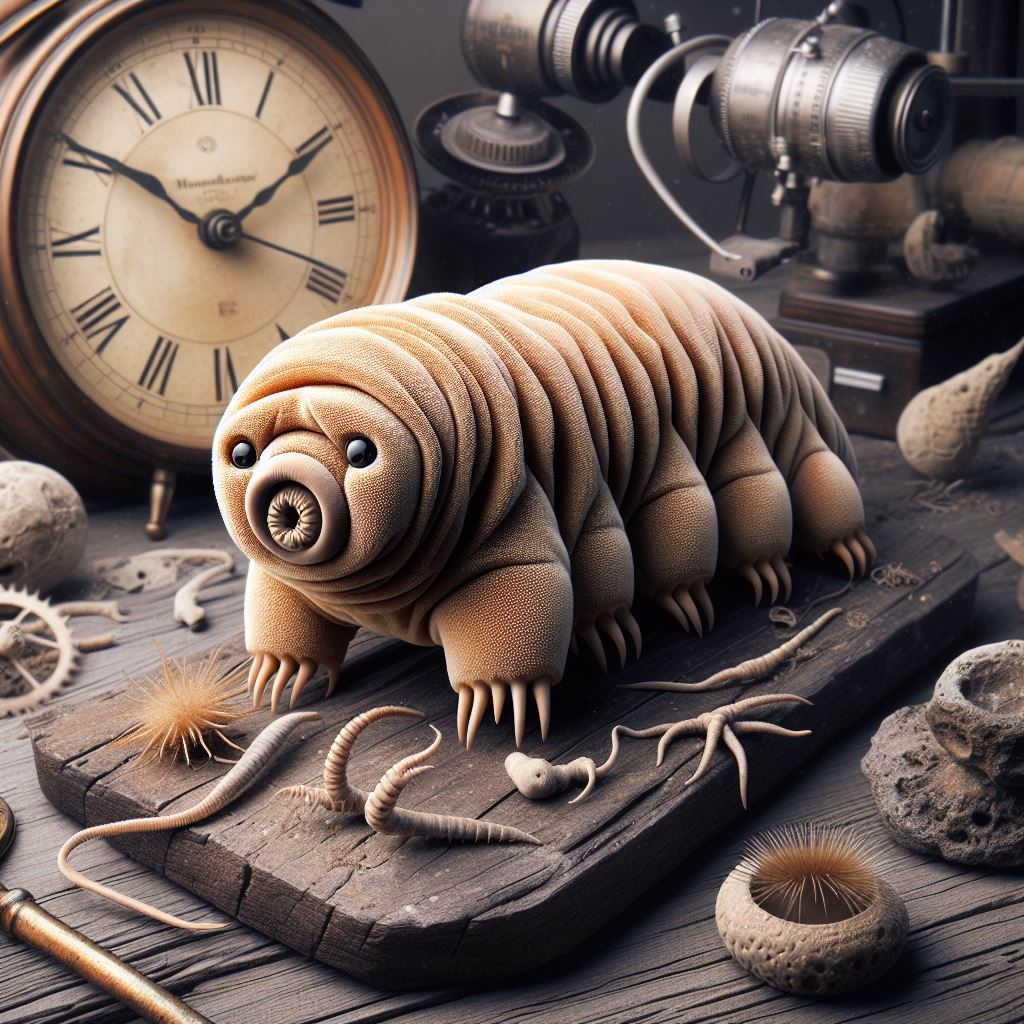
Tardigrades (water bears)

- Tardigrades are the most appealing of all the Big Five mainly due to their superstar status of being able to survive in the vacuum of space, radiation, high pressures and a whole host of other exteme conditions.
- Life span: depending on the species. Tardigrades can live for several months to a few years, but some species have been known to survive extreme conditions by entering cryptobiosis as a tun.
- Life cycle: Tardigrades have simple life cycles, typically consisting of egg, juvenile, and adult stages. In extreme conditions, tardigrades turn into a tun and can survive for decades.
- First evolved: Very likely the Cambrian period (500 million years ago), but they possibly evolved in the Precambrian period.
- First discovered: Tardigrades were first described by German zoologist Johann August Ephraim Goeze in 1773, calling them ‘little water bears’. In 1777, the Italian biologist Lazzaro Spallanzani named them Tardigrada which means “slow steppers”.
- The future: Tardigrades produce proteins that help them survive as a tun, these proteins could be helpful in medicines such as stabilising vaccines. Not only are we fascinated by there survival, but they play an important role in ecosystems, often helping new ecosystems develop in new places (they are a pioneer species). Finally, astrobiologists are interested in whether tardigrades could inhabit or even exist on other planets.
Gastrotrichs (hairy belly flat worms)

- Gastrotrichs are the most mysterious of the Big Five organisms. They are the third most abundant organism in freshwater sediments, but we barely know much about them.
- Life span: 3 days to 6 months, depending on the species.
- Life cycle: egg, juvenile, adult. However, adults can lay two types of egg, one that hatches quickly and one that hatches when the conditions are favorable.
- First evolved: uncertain. We have no fossil records or sediment records.
- First discovered: The Russian zoologist Élie Metchnikoff in 1865 named them gastrotriches meaning ‘hairy-bellies’.
- The future: We know that gastrotrichs are likely to be important in sediment ecosystems, particularly with cycling nutrients. Other than that, we still know little about their life cycle, reproduction and feeding. We still don’t know exactly when they first evolved nor exactly where they fit into the tree of life. There is research going on right now into these mysterious flat worms.
Ideas for learning activities
Watch the BBC Live Lesson for British Science Week that features Moss Safari.
Do your own Moss Safari using the free downloadable resources and focus on questions about an aspect of time.
Buy the Edulab Official Moss Safari kits for your classes to do several Moss Safaris.
Make a time line – a geological time line or human history timeline to compare these animals.
Send your projects, work, photos to feature in the Moss Safari Gallery.
Discussion questions
Life History: Although all these animals are in different phyla, what do they have in common?
Human History: Why is it that most of the Big Five animals were only discovered and described from the 1700s?
Geological History: Why is it difficult to be certain about when these animals first evolved in geological time?
 Moss Safari