I was skeptical that teachers or the general public might pay to watch a Moss Safari, but did a trial as a charitable event. Eighteen people signed up for the Moss Safari and watched it online on Tuesday 8th March 4:30-6:00 PM. It was hosted by the Association for Science Education (ASE) and all the proceeds went to the ASE.
My ambitions for Moss Safari are to give everyone an opportunity to see what lives in moss, to understand the importance for moss in and of itself and to consider how the organisms that live in moss fit within the global ecosystem. Alongside this, moss provides a great opportunity to highlight that science is an ongoing endeavour, there is still so much to learn and that amateur and professional research can contribute to this.
What happened on the Moss Safari?
I welcomed the visitors online (which included 25 primary school children from two schools) to the Moss Safari and explained what to expect from the expedition. Keeping in mind I had an audience ranging from 6 years to retirement age, I had to think carefully about how to pitch it. I have been a teacher for a long time, so know the importance of introducing new vocabulary in sequence and using it in context, gradually bringing the key concepts I want to teach about.
The introduction to the expedition included:
- The features of the habitat, moss (from my roof)
- The the moss ecosystem
- The features of the ‘Big Five’ to look out for: moss mites, nematodes, rotifers, tardigrades and gastroriches.
- The scale of what we will see (everything smaller than 1 millimetre)
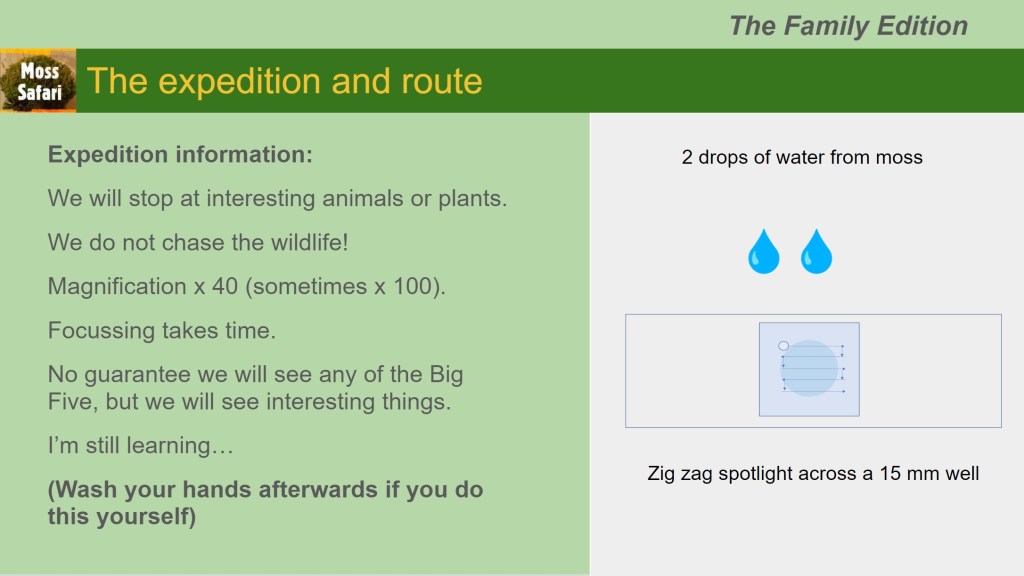
- The expedition rules and ‘safety’ (Figure 1)
The Moss Safari got off to an exciting start with finding two of our Big Five with the first run across the slide. We quickly came across a feeding rotifer who we watched for sometime (Figure 2). I narrated what we were seeing, particularly the adaptations for feeding, but also the fascinating facts about how they survive drying out.
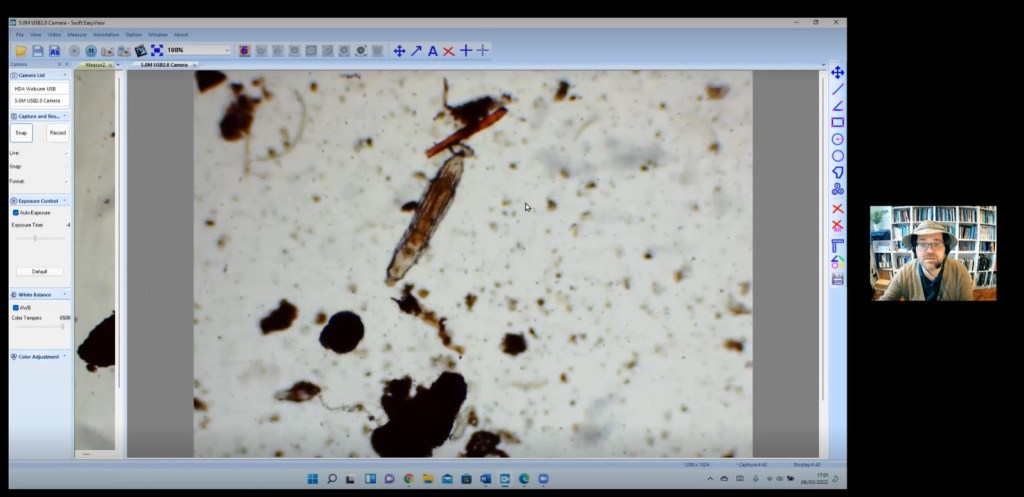
We also observed filamentous algae, testate amoeba (particularly Arcella), cyanobacteria and diatoms.
The second of the of the Big Five we found was the a thrashing nematode, so I told the viewers about the adaptations of nematodes that live in moss. We later saw a stationary nematode that we could look at in more detail.
Despite our hope, as is the nature of safaris, we didn’t get to see all out Big Five.
We finished with questions and discussion. The primary school children asked many wonderful questions, most of which I could answer.
The reviews are in!
So, what did the viewers think? I have taken comments from the chat function and the feedback form I asked them to complete after the event.
Some quick stats:
I found the session interesting 100%
I found the session enjoyable 100%
I learnt something new from the session 100%
The session inspired me to do a Moss Safari myself 100%
I would recommend others to join a Moss Safari session like this one. 100%
I will consider buying a microscope for myself or someone else due to this session 50%
Some highlights
Seeing the rotifer feeding
Seeing the organisms and the thorough knowledge of the speaker, letting us know what everything is
Seeing the organisms moving around and learning about them, the element of not knowing what you might find
Seeing and learning about the microworld, seeing how children are expanding knowledge.
How to get a good sample and identifying the organisms
Additional Comments
Fantastic event, saw and learned so much, can’t wait to use this with my students now!
Thank you so much for answering the children’s questions, they loved having them read out and answered live on air.
Some video of field collections of different types.
Just more of them ! Details on how you could arrange a school visit
Reflections
Thank you to all the people that signed up and for taking the time to feedback. The event raised just over £175 for the ASE.
I was pleased how well this went. I was worried about the age range and background of the audience, but think I was able to pitch appropriately. I want to continue honing my skills of using the microscope and narrating. I want to increase my knowledge and confidence in being able answer all questions.
Representatives from Philip Harris also attended and were able to kindly field some questions about starter microscopes. Thank you.
Did I meet my aims of Moss Safari? I did inspire my audience, showing them things they had not seen or even heard of before. They were definitely interested and the questions showed genuine curiosity.
I feel encouraged and I will do this type of event again. If you would like me to do one for your charity or organisation, please get in touch with me. If you would like me to visit your school, I can travel locally (South East), contact me for dates, details and prices.
All the resources to do your own Moss Safari are free to download here.
 Moss Safari