Moss Safari Big Five – 1 Nematodes – thrashing (or stationary) worms
What to look out for
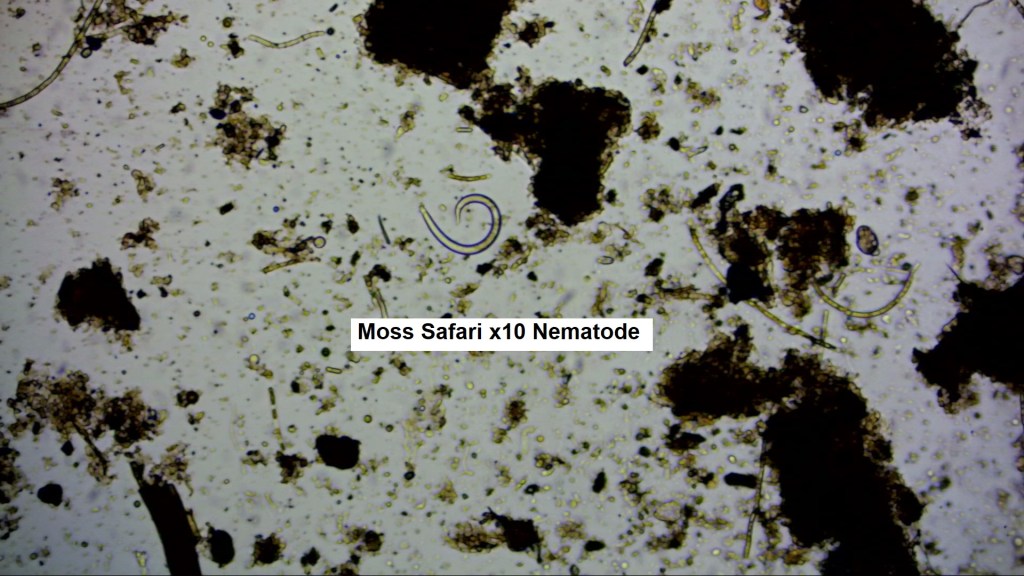
I find at least one nematode in almost every Moss Safari. Just when I’ve settled at looking at something else of interest, a nematode will come thrashing past, disrupting the field, sending all other organisms in all directions in the water droplet.
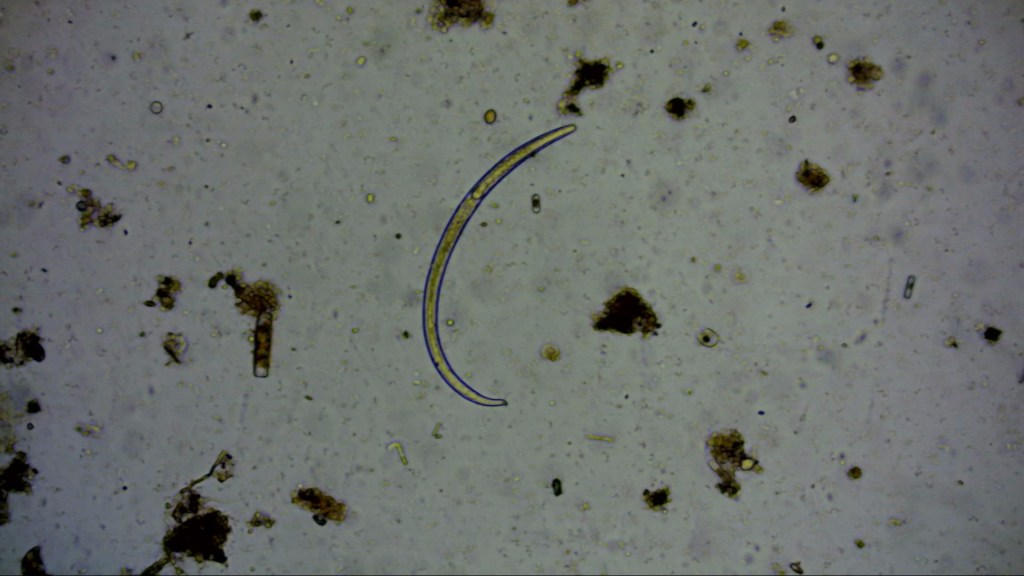
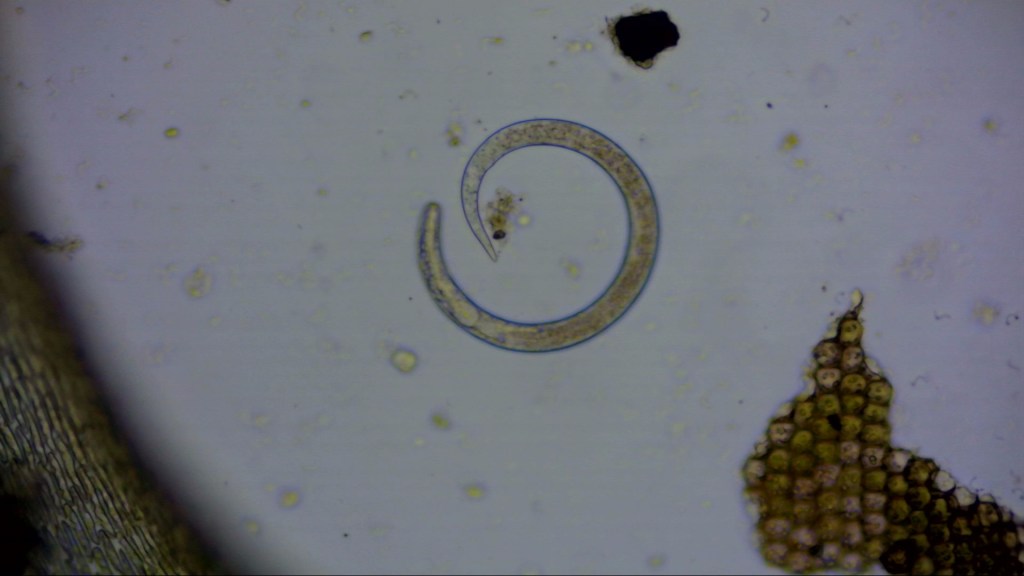
Nematodes are unmistakable in appearance. You could say the snake of the African Safari, but really nothing like a snake. These not vertebrates, they are from the a family of worms called ‘roundworms.’ They are transparent long ‘tubes’ under a light microscope, with another tube along their length (their digestive system).
The nematodes I usually see on a Moss Safari are either thrashing: flexing their bodies violently, or stationary: not moving, in a ‘sleeping’ state or maybe dead.
When they are stationary, it is worth taking some time to observe them using a higher magnification. Start at one end, hopefully the mouth end. Try focussing on the shape of the mouth, then move along the body length, following the gut (digestive system) in which you might see some food being digested, some other reproductive organs may be visible and then at the pointy rear end (anus).
Some nematode facts
- Their name comes from the Latin word ‘thread-like’ because without a microscope, larger nematodes look like threads.
- It is very difficult to tell one species from another, so nematologists (scientists who study nematodes) are not agreed on the estimated number of species of nematode. Some think there are about 25,000 species of nematodes, others think there might be up to one million.
- Nematodes live in nearly every ecosystem on Earth: freshwater, salt water, and soils from the Tropics to Polar regions.
- By studying nematodes, we have learnt a lot about human physiology including, human development of the foetus, the nervous system (including the genes involved in Muscular Dystrophy and Alzheimer’s), the aging process, and sleep.
Famous nematodes
- The most studied nematode is Caenorhabditis elegans, know as C. elegans for short. It is known as a ‘model species’ – one that scientists focus their studies on.
- C. elegans was the first multicellular organism to have its whole genome sequenced (DNA code) and the first to have its connectome (neural network) mapped.
- Despite the tragic Space Shuttle Columbia explosion in 2003, the nematodes on board survived. Nematodes continue to be used in research on the International Space Station.
- So far, three Nobel Prizes have been awarded for work using C. elegans.
My learning
I am yet to identify the species of nematodes that live in my roof moss. To date, I have not yet been able to distinguish between males and female, but I have only recently learnt that males have blunter tail. More to follow….
 Moss Safari